Thursday, December 21, 2006

Winter in One Minute


The news is on in the background. The weather forecaster has just announced that winter officially begins in one minute. Silly, isn't it, that we mark time in minutes? "I'll be there in a minute" or "Any minute now?"

This is the shortest day of the year. We felt it approaching yesterday as we skied our way around a loop that passed by a lazy spot on the Wenatchee River. We stopped, hearing the sound of our own breath, the rapid beats of our hearts, and the gurgling call of three Ravens tumbling overhead. Later, a Pileated woodpecker would bounce up a dead snag leaving large chunks of bark at our feet.

The skiing was good especially after the storm of last week. A million people without power and we were two in a million. We bundled up in a sleeping bag and sat seance style around mountains of candles. We listened intently to the battery operated radio to a show not worthy of our time, but we felt it necessary seeing how it was the storm of the century.

And then we ate as much as we could from our fridge, fearing food would go bad. Our stovetop operates with gas so I made scrambled eggs with cream cheese, fried up some bacon and lightly toasted some homemade bread by flipping it in the pan. Ann made Indian food from cans in the pantry and then Lisa and Jeanne, who were staying with us then, decided to go out only to find that nothing was open. So they ate PBJ sandwiches as we giggled in candle glow.

We faired well. Only 20 hours without power, while others are still waiting today and will wait, so it is predicted, until after Christmas.

I spent my birthday on Saturday with Peggy, the horse woman, and Ann. It was exactly how it should be on one's 48th birthday. Peggy's house had no power, but she had a woodstove and parrot, Tao of Parrot, who entertained us with his impressions of donkeys and horses and his need to "rock and roll." Peggy is delightful and Ann and I have vowed to visit her more when time allows. We went out to lunch after playing with her horses and treated ourselves to pie as it was Peggy's birthday the day before mine. Small wonders, eh? It was delicious.

We left on Monday for Jeanne and Lisa's cabin by the river, arriving late in the afternoon, too chilled to do anything else but lie on the couch and read. We woke early, had our coffee and cocoa, and then headed out to ski. Though we started at the golf course, our route took us up a ridge where the skiing was perfect if only a tad bit too cold to plop ourselves down for lunch. So we ate quickly, standing up and smacking our frozen lips around homemade bread and thick layers of peanut butter.

The ski down from the ridge was frosty, but fun and what took us three hours to ski up, took us only an hour to ski down. Brrrrrr!

Back at the cabin we warmed up by the stove and feasted on pasta with olive oil, olives, and a pile of parmesan cheese. Skiing is great exercise, so we felt obliged to feast well and we did.

We read more, solved Sudoku puzzles, and when the darkness surrounded us completely, we fell to sleep wrapped in a soft downy comforter atop a warm feather bed.

The next day we packed up to leave, but before we got on the highway, we put skiis down for one more tour through the woods. This time, the trail took us into the trees, down by the river, and back round again. It was rough going, but we burned enough calories to eat our sandwiches of homemade bread, French brie, and smoked salmon. Cardiac Sandwiches. Blood Thickener Sandwiches. Perhaps the best sandwich I've ever eaten out on the trail.

On the drive out toward the highway, we pulled over the truck and Ann snapped this picture.


Funny how we measure our lives in minutes. One minute until winter has passed. Minutes ago, the sun set and autumn left.

Any minute now we'll leave to join our friends for dinner. Any minute now we'll laugh at the silly Christmas gifts we got each other. Any minute now we'll smile at each other, share our time over pizza or soup, and then head home. Any minute now we'll lay our heads on our pillows and float off for just a minute until tomorrow, when the minutes count themselves right back into today.

I shall be there in a minute.

Thursday, December 14, 2006

Claiming Space: Thoughts on Girls, Teaching, and Horses

She’s wearing pink today. She always wears pink. Her shoelaces are pink. Her big puffy jacket is pink. Pink butterflies are embroidered on her jeans. Her hair tie is bright pink. She stands in the middle of the horse arena and the instructor asks her to “claim her space,” to push the horse’s head out of her way without touching the horse, with just energy, powerful energy.

But it’s hard to claim your space when pushed around by a thousand pound horse. You feel intimidated. You feel uncertain. You feel small. It's even harder to claim your space when you're just 10 years old and a girl and you suffer from panic attacks and pathologically shyness, and are taking medications for anxiety. It’s hard to claim space when you’re dressed in the softness of your pink.

Everything you've experienced up until this point has been about fear -- fear of the future, fear of social interactions, fear of making a mistake, fear of just about everyone except your immediate family. And now, standing in the middle of a large arena, the wind whipping the rain sideways onto the metal roof, the sky dark and violent with an ensuing storm, you are asked to claim your space, to move the head of a large gelding out of your way, demand that he respect you as if you were as big as he was. As if you were an adult. As if you were someone who wasn't afraid, wasn't worried all the time, wasn't able to breathe in stressful situations.

As if you were a boy.


For the past three years, I have been teaching at a private girls’ school. For the first 18 years of my career, I taught in co-ed public schools. When people find out I’ve made such a transition, they ask me two questions. “What’s the difference between public and private school?” and “Is it easier to teach boys or girls?”

I am always stumped by their questions. The answers are complicated and only recently have I begun to really think about the differences, the similarities. This is perhaps because I am as exhausted as a private school teacher as I was as a public school teacher. I am just as overwhelmed as a teacher of only girls as I was as a teacher of both boys and girls. Everyone wants there to be a dramatic difference and there isn’t really.

It’s about energy. I exert the same amount, but what I get back in return is slightly greater, slightly more meaningful at a private school, particularly at this private girls’ school whose mission is to create the next generation of “Women World Leaders.”

No one really understands my energy explanation. They think it has to do with the chaotic state of public education, the large class sizes, and state testing requirements. But that’s not really it. I work just as hard with 16 students as I did with 125. I come home at the end of a long day just as tired, emotionally and physically, just as committed to creating a meaningful educational experience for my private students as I did for my public students. The expectations are just as high, if not higher, but when I sit down to talk with my girls or their families, or even my colleagues, energy comes back to me. It isn’t sucked out day after day. At the end of a long day, I am exhausted, but rejuvenated if only a little; emotionally fatigued, but appreciated as well.

I’m not certain if the energy shift is really the difference between a private school and a public one, or more a shift from co-ed to all-girls education. My energy just feels more in line with the energy of my students. It’s not perfect, by any means, but it’s better. There isn’t a disconnect and when there is, I’m better able to realign myself to the rhythm of girls alone than to boys and girls together.


“Energy,” Peggy tells me, “is not either or. It is both masculine and feminine. The balance of that energy depends on many factors. My job is to find an equal balance. The horses help me do that.” At first blush, Peggy Gilmer looks like one of the grandmothers of my students. In her late 50’s or early 60’s, her face is round and kind and calm. She smiles on one corner of her mouth. Slowly, the other side follows. Her glasses are fashionable, but slightly askew. Her hands move while she talks. They float, accentuating her words, her passion for the work she does.

With a degree in psychology and another in systems analysis, Peggy is an Executive Coach, a consultant who works with high-powered CEO’s to help shape influential world businesses like Boeing, NOAA, and Citibank. “Rewiring People and Organizations” claims the banner on her website. Peggy has agreed to work with my class of 5th graders, all girls in what we’re calling “Leadership Training,” but it is much more than that.

Much more.


Stacy stands in the ring, her shoulders hunched. She has been my student for three months and I have only heard her say two words –“thank you” – and they were whispered. In response to direct questions, she curls into herself. Her lips clamp together like a clam shell. She nods her answers or just retreats into a small ball of nothingness – avoiding, afraid.

These are the kinds of students with which I struggle. I worry they will be dominated throughout their lives, that the bullies of the world will see “victim” written across their backs and attack. As a teacher, I find it easier to work with loud girls, brash and tough girls. The girlie-girls make me nervous and the quiet, shy girlie-girls make me very nervous. I don’t know how to access them, to build a relationship of trust, or help them grow into “women world leaders.”

Stacy is such a student. She is afraid of the world and walks through it as if the air bruises her. It is only through her school work that I see glimpses of who she is under all that fear.

Stacy loves horses. She draws them on her notebook and inside the margins of her assignments. Horses running, horses leaping over fences, horses standing like deities in the wind. The other students marvel over her artistic skills. “Look at the mane,” one student gasps, “It’s like the horse is actually moving.” They point out attributes of her drawings they wish they could emulate – the curve of the muscles, the shape of the long head, the strength of the shoulders. Stacy stands by her drawing, her head bowed, her arms and legs desperately trying to create one line, one invisible stroke of nonexistence.

But when we arrive at Peggy’s farm, Stacy is the first to walk up to the horses, her hand extended. When Peggy invites Stacy into the ring, the horses shift their attention and walk, in unison over to her. Suddenly, Stacy’s shoulders straighten, her head lifts, and with her arm extended, she reaches out to the mares moving patiently toward her.

“I have never seen the horses react this way,” Peggy whispers to me. “This girl is very powerful.”

I have never thought of Stacy as powerful. Shy, unassuming, and fragile, yes, but never as a child who possesses any authority. Clearly, though there is a well of strength hiding behind the folded lips and bowed head. The horses feel it, and as Stacy walks slowly toward the feistiest of mares all of us watching feel it, too. Without being told to claim her space, Stacy has done just that. For the rest of the session with Peggy and the horses, Stacy transforms into a girl I never knew existed – confident, brave, and commanding.


“Males and females are wired differently.” Weeks later Peggy sits across from me at her dining room table. Her house is modest, though during our conversation she receives a phone call from the vice president of Boeing who is on her way to Japan for a big presentation. Peggy offers her advice on the upcoming appearance, stressing key points again and again. While they talk, I look around at the small dining room, clean, but cluttered with important papers, horse placemats, and Peggy’s working gloves. I have asked to meet with her and carry on our conversation about leadership, about claiming space, and of particular interest to me, education.
“Males are wired for protection and dominance. They know how to claim and keep space. Women are wired for care and nurturing of the community. It sounds sexist, but it’s simple biology and each – the male and female – are valid and necessary for survival of the society.”

Peggy isn’t telling me anything I don’t already know. I’ve seen it throughout my career. I joke with my colleagues that some days I wish I worked at a boys’ school where disputes were handled with a physical fight and then everyone makes up and all is fine. In a girls’ school, fights are all underneath the surface. There are no punches. There’s never any blood. There’s gossip and ally-building and hurt feelings and anguish for months, perhaps years. Girls work the friendships, surrounding themselves with loyalty, sneaking off into corners to bad-mouth another group of girls or, their favorite target, the loaner, the wall-flower, the girl who stands alone.

“The masculine is pegged for speed,” Peggy continues, “Not content. The feminine is all about content and not speed. The masculine is about the end result. The feminine is about relationships.”

Gossiping versus punching, lobbying for allies versus taking care of oneself. Girls versus boys. Boys claim space forcefully. Girls claim space insidiously. I’ve watched kids try to claim space throughout my 21 years of teaching. It doesn’t matter the age or the gender or the funding of the school. Kids claim space in a variety of ways.

Some claim space constantly, through their behavior or their loudness, their size or their brashness. Some kids are bold. They take risks to claim space, slyly working their way into the spotlight to make others mad, to make others laugh, to make others notice them. Some kids are quiet, working behind the scenes to manipulate their peers or their teachers. Some claim space by being a bully, others by being a victim. Some students claim space through their talents – their art, their athletic ability, their strengths in math or public speaking. Some kids claim space throughout their lives, while others never do. Some end up in the principal’s office or jail, others end up class president or state senator.

Some claim space positively. Many claim it negatively. Some are rewarded for their efforts. Others are punished. It would take a sociological study to break it down by race, economic status, sexual orientation, and gender, but the fact remains – adolescence is all about claiming or not claiming space, about carving out a moment in your immediate universe. It’s all about figuring out how you matter in the world.

Until I met Peggy Gilmer, I never realized that, as a teacher, my job is primarily about teaching kids to claim space positively, to their fullest potential so they might achieve whatever they set out for themselves to achieve. Be it finding success in school or getting through their lives without being shot or overcoming the abusive parent or a life of poverty and neglect, if I can teach them to claim space in the world in a way that not only makes a difference in their lives, but in the lives of others, then I have done my job well.

But oh, what a job.


I think of Alice, a spunky 10 year old who flips her hair when she’s angry. Her eyes roll in perfect timing to the tsk tsk of her tongue. “I don’t mean to be difficult,” she said to me one day, “but I can’t really work with her.” She tosses her long blond hair in the direction of Delilah, a tall 5th grader who, despite her ballet lessons, falls off chairs and knocks over her lunch almost daily.

I work with Alice for awhile, talking with her about appreciating differences, accepting Delilah for who she is and not hating her just because they struggle together. But Alice will have none of it. Eventually, I give up and let the two of them rub each other the wrong way. There’s too much to do in our class and by the end of the day, there are papers I must grade and meetings I must attend.

Then we head out on our field trip to Peggy’s farm. Both girls love horses. They both squeal with excitement. They prattle on to their significant friends about their thrill of going to work on the farm.

I divide the class into four groups of four girls each. I put Alice and Delilah in the same group. They are not pleased. I’m thinking, They need to see how they are more alike than different, but I worry the whole thing will backfire and the horses will stampede with the pulsating anger radiating between them.

Delilah goes into the arena first. Peggy talks with her quietly. “Have you worked with horses before?” she asks, her hands gently on Delilah’s shoulders.

“Yeah,” Delilah says shyly, which surprises me as she’s generally gregarious and boastful.

They approach the horse, get acquainted, stroking the long, powerful neck of Savannah, the steadiest of Peggy’s mares. Delilah has watched other classmates work with Peggy all morning so she knows what she will be asked to do. Peggy asks her to extend her hand, palm up, and invite the horse to follow her, but Savannah will have none of it. She stands at the railing, ears erect, watching the other horses graze in the pasture.

“Get her attention,” Peggy commands. “Use a strong voice. Call her name as if you are the one in charge.”

Delilah giggles. She is self conscious, aware of the other girls watching her. Aware of Alice watching her. “Savannah,” she says half-heartedly, her voice high-pitched and strained.

Peggy walks over to Delilah. She places her hands on Delilah’s shoulders again and says, “Where’s that strong voice? You must set the little girl voice aside. Little girl voices are not leader voices.”

Delilah tries again and this time we all hear her, loud and strong, forceful. “Savannah!”

Savannah turns, then drops her head to saunter over to where Delilah is standing with her arm firmly extended, her palm up.

“Slow down and keep your head high,” Peggy instructs, “And look to where you want to go. No one wants to follow a leader who doesn’t know where she is going.”

Delilah straightens, fixes her gaze on an orange cone at the other end of the arena, and walks with confident, meaningful strides. Savannah follows, inches away from Delilah’s outstretched hand.

It’s a ballet. Savannah the ballerina, Delilah the self-assured male dancer. I look over and I see Alice smiling, applauding softly at her classmate’s success.


“Horses,” Peggy tells me, “are balanced energy. The herd comes first. Sure, they establish the alpha and the beta right away and the alpha always eats first, but once the hierarchy is firmly set up, they are connected, a unit who breathes together, who are wired together. There is no repression of the feminine. They are holistic. They are one.”

The feminine is about relationships. The masculine is about the end result. How do we achieve balance in a feminine repressed society? A key phrase in our school’s mission statement is that we “create women world leaders.” Prospective parents always want to know how we achieve this goal. After working with Peggy, I’m not certain anymore. I thought we were grounded in feminist principles, but the more I think about the work we do, the more I realize we are driven by masculine models of leadership and organization.

I see it in our classrooms every day. We create huge projects for the girls to complete. They have a great deal of choice and will only succeed if they take initiative and are self-directed, but achieving the end goal is driven not by process but by time – due dates, presentation dates, and the ultimate event, a public performance of their learning.

I see it in my own teaching. I make decisions daily about what to teach and what to sacrifice. I push the girls to conform to the model of what I think is acceptable and valid. I define what success is and how it will be achieved. I try to build relationships with my students, to find out their interests and strengths, but I always feel pressured to deliver curriculum and the discussions about who they are and who they want to be often get pushed aside so we might reach a specific goal.

I see it in our faculty meetings, too. We are all working to capacity. Everyone, from the school secretary to the admissions office to the classroom teachers, is putting in more hours in a day than are healthy. We start the beginning of the year all thin and relaxed and by the end of the year we’re all 15 pounds heavier, exhausted, and cranky.

“I’m worried about the pattern we’re creating,” says Bill, an 8th grade teacher. He is a gentle, thoughtful man who, I’ve come to realize is very feminine in his thinking. “We are doing more each year because opportunities present themselves and we feel we can’t pass them up, so we don’t and soon we’re all doing more and feeling the pressure to succeed beyond all standards. Is that the culture we want to create at this school?”

It’s a valid question. One we don’t have time to really answer. Our meeting is coming to an end and we must race back to our classrooms to be with the girls again. Bill goes on, “We can justify every decision and choice we’ve made. We can find validity in all of it, but the end result is that we are all stretched beyond our capacity.”

The end result. What have we sacrificed for the end result? What message are we, a girls’ school, sending to our future women leaders? We are about speed. We are about outcomes. We drive with time, as Peggy has said. The masculine model is sink or swim. The masculine model is speed to goal. It’s about the future. The feminine model takes a developmental look at the process. The feminine model is respectful of where we (the individual or the institution) are now with an awareness of where we want to go. It is both present and future. Future cannot exist without an awareness of the now.

At work, we are about the future…future world women leaders, future of the school, sustainability of the organization for the long-term. We are not in the now, in the present. This is not much different than what I experienced in public schools only this time, the entire faculty and staff of the private school is involved in the process. The direction of the school is not driven by state standards or lost in overworked committees. It’s not driven by a school board who oversees more than one school. It is not governed by state and national regulations or required, under threat of severe penalties, to leave no child behind. It is driven by us and we are following the same model most schools follow, a masculine model.

When parents ask me what’s the difference between private and public school, between co-ed and all girls I search for the differences, but in the end, there aren’t many. We are still driven by a masculine model, one that defines success by the end result and not the relationships along the way.

It makes sense, of course, that this is the way we operate. All of us have succeeded under such models. They are familiar to us. We’ve learned to thrive under a male model of leadership, in organizations that are goal oriented and time-driven. We are, in fact, rewarded for our ability to function within such a system. We know how to claim space in a masculine world. As teachers, we pass this ability onto our students without knowing what we have suppressed. We structure curriculum that is built on incentives such as meeting deadlines, following instructions, and completing a task, but in the process we have forsaken much of the nurturing and compassion needed to sustain a community.

While our girls succeed once they leave our school, they succeed within that male model. As a girls’ school we are sustaining the very system that keeps our world out of balance. As a girls’ school we are, unintentionally perhaps, we are creating future women leaders who will transform the world not by envisioning a new form of leadership, but by operating within the confines of the one that currently exists.

“There must be a structural tension between the leader and the organization,” Peggy tells me as the wind whips more rain against the kitchen window. “I ask the girls to connect with the horse first, to build a relationship. Only then can they lead, only then will the horse follow. If there is no relationship, if there is no feminine energy balanced with the masculine energy, the horse will sense danger and not follow. The horse will not accept you as part of the herd, as the leader of the herd.

“You go faster in the end,” Peggy concludes, “if you go slowly in the beginning, if you build those relationships. Once you attend to the people of the organization before you attend to the goals, the goals will be achieved more quickly and more meaningfully. Like a herd of horses, you will be wired together, you will breathe together and each person will have value in that organization.”

At the end of our conversation, Peggy and I walk to the arena where she is scheduled to work with one of my students in a private session. As I watch Peggy work, I try to envision how our school would have to change to reflect this balance between male energy and female energy. Soon, though, my thoughts are lost as I am caught up in watching the transformation I seek for my work happen in the heart of a 10 year old girl.


“Would you like to get on the horse?” Peggy asks Ivy. The wind has died down and the rain has stopped. The clouds hang lighter in the sky and the green pastures glow in contrast to the gray backdrop.

Ivy has worked for over an hour with Peggy. As I’ve watched, Ivy has never really relaxed, felt confident or at ease with the horse in the arena. She goes through the motions, attempting to breathe in and out like a horse as Peggy has instructed her, a puff of air and flapping lips with every exhale. But she is tense through the entire session.

When Peggy asks if she wants to mount the horse, Ivy looks up big-eyed and says in her girly voice, “I’d like to, but I’m afraid.”

“What courage you have,” Peggy beams. “I like that you are willing to try something you are afraid of. That takes a great deal of bravery.”

For the next half hour, Peggy works with Ivy to get her on the horse. Peggy asks me to enter the arena and stand on the left side of the horse so that Ivy doesn’t feel as if she is going to fall while mounting onto the bare back. Ivy doesn’t want to touch the horse’s mane, she’s afraid the horse will move if she grabs too hard or pulls too strongly. I offer my hand and Ivy clasps it firmly cutting off circulation to the tips of my fingers.

With much coaxing, Ivy makes it to the top of the horse, but she is frozen in fear. She holds my hand. She holds Peggy’s hand and every time the horse shifts her weight, Ivy gasps in another tense gulp of air. She is not breathing. The air that goes in never comes out.

Peggy encourages her. “Take a deep breath in and let it out slowly. The horse is going no where. She wants you to trust her.” But Ivy, in her pink shoes and pink coat is white with fear.

“Can I get down now?” Her voice rises at the end. It is high-pitched and fearful. It’s a voice I hear often when Ivy’s in class. She is uncertain and double checks every instruction. She wants reassurance she is doing exactly what is asked of her and worries in creative moments when there is no right answer.

“You can get down in a minute,” Peggy tells her, “But first, I want you to sit on top of that horse confidently. I want you to breathe in the power you have while sitting up there and realize how much courage you’ve shown today. I want you to breathe in that courage and power to the bottom of your belly and let out that breath with determination and pride.”

Ivy inhales. Her grip on my hand relaxes ever so slightly. She exhales and her shoulders move away from her ears, her head lifts. “Now you can get down.” With that, Peggy grabs Ivy by the waist and lowers her to the ground. They embrace, stroke the horse, and then Peggy says, “Okay, take the lead rope and go play with that horse. Practice everything we’ve done today, okay?”

Ivy takes the rope and moves around the arena a changed girl. She maneuvers the horse between the slalom of orange cones and Savannah follows. Ivy’s whole disposition has transformed. Everything Peggy asked her to do earlier Ivy does now only this time without fear, without hesitation, without tension of any kind.

“Why now?” I ask. “Why is she able to do those tasks more confidently than before?”

“I took her to the edge,” Peggy explains. “I asked her to go to the edge of what was comfortable for her, to go beyond her fear by sitting on that horse. Now, the tasks she once thought were too difficult are easy. She has a relationship with that horse.”

She has a relationship with the horse, I think, but she also has a relationship with Peggy. End result? Ivy can claim her space and lead the horse in any direction she wants her to go.


We all claim space differently, but we are not either or, male or female. The space we claim is both feminine and masculine though we tend to glorify the latter and suppress the former. We even do this at an innovative girls’ school partly because it is the predominate model we have all grown up in, worked in, succeeded in, but partly, perhaps, because we’ve never envisioned a different model, a different way of being.

“I take the girls at whatever level of bravery they want,” Peggy tells me as we walk back to the main house. “It never fails. Bravery will jump right up and claim the space.”

On my drive home, I am lost in my thoughts. What is my level of bravery? How do I balance my energy? What patterns have I assumed over 21 years of teaching that have depleted my energy, skewed my balance? How do I reclaim it? How do I take what I have learned and apply it to my life, to my work and have it actually make a difference? How do I transform in an effort to transform my students and my place of work? What space can I claim and how can that space be innovatively different than the space I’ve claimed my entire career?

It begins, I think, with Ivy. Afraid, worried, apprehensive. It begins with Stacy. Shy, fearful, and timid. It begins with Alice and Delilah. Self-conscious, intimidated, uncooperative. It begins with an arm extended, a powerful voice, eyes on the destination. It begins by claiming your space, moving the head of a large gelding out of your way, demanding his respect as if you were as big as he was. As if you are a leader. As if you are someone of value and patience, confidence and compassion.

As if you are a girl – strong, whole, and brave.

Wednesday, December 13, 2006

Holiday Cheer

The week before school breaks for the winter holiday is, perhaps, the longest week of the year. It's dark, it's cold, and this year, like last, is particularly wet.

And now, windy.

The forecasters of the forecast are predicting 70 mph winds tonight. That's a whole lot of blowing. I heard a friend of a friend describe the weather as "blowing rain" the other day and that's precisely what it's done now for 2 days straight. Tonight shall be no different.

I'm in search of my Holiday Cheer these days. Having a birthday (this Saturday) near the Christmas Chaos has always made it difficult for me to focus. There is shopping to do and though I'm nearly done, nothing feels actually complete or finished. There is wrapping to do, but I may just fall into my brother's habit and stay up late Christmas Eve and wrap like a fiend, though I don't buy nearly as many presents as everyone else does.

But there's also a birthday to celebrate and often I feel apologetic that my birthday festivities must interrupt the great anticipatory hoopla of Christmas.

Perhaps all would have been better had I been born Jewish, though my co-worker says being Jewish is just as horrible as having a birthday around Christmas. "You are," she tells me, "bombarded with Christmas every where." And she's right...the musak in the grocery stores, the lights on the houses, the silly little ornaments people pin to their lapels, the inordinate amount of red sweaters...it's hard to focus on anything BUT Christmas. Even the Iraq War seems to have taken a back seat and that is far more upsetting than no one really noticing my birthday.

Maybe Holiday Cheer will arrive on Friday when I am handed gift after gift from my students. Mugs are my least favorite, but I'm sure to get at least one snowman or a Santa. And there's always the chocolate. Mounds and mounds of it with a Starbuck's card tuck in neatly to a handmade greeting card or some gift that requires me to ask the giver exactly what it is and what it's used for.

I'm not complaining. I am very thankful for the gifts my students offer. They are so sweet when they shyly put it on my desk or bounce up and down asking me to "Open it, open it now!" I suppose, like anyone, the kids make Christmas Christmas and that's the kind of cheer that gets me more in the spirit.

Of course this year, the plethora of candles that come my way just may come in handy if we, once again, lose our power. As I did on Monday afternoon, I'll set up a seance of candles on our kitchen island and try not to poison myself in the perfume of smells venting from the candles shaped like elves or snowflakes!

So, bring it on, I say -- the wind and the winter, the chaos and the Christmas. I'll take a short moment on Saturday to send a blessing to my parents for birthing me and a blessing to my body for keeping me here and healthy, then I'll strap on my snowshoes and gallop off into the snow singing one Christmas Carol after another.

Sunday, December 10, 2006

Bah Humbug With A Smile


My father played Scrooge. A contemplative Scrooge. A Scrooge with a bad eye, a goatee and not so much need for greed, but Scrooge nonetheless.


Fossilguy played Marley. A bit blurry, but still clearly dead.


Bookworm was the ghost of Christmas Past, elegant in red, with cough syrup and Ricola under her chair "offstage." But she was the perfect spirit for my father's Scrooge. She helped transform him by flying off stage, hands joined, eyes focused on their scripts.


Scrooge's maids and undertaker stealing what they could after Scrooge's death-in-one-possible future.


The scripts were so important, as you can tell.


But more important than the scripts, was the bell, ringing in the spirit of Christmas.

Thank you all for a joyful day!

Sunday, December 03, 2006

Satsuma in the Snow


Today's adventure was not any warmer. 23 degrees, but we were in the snow, skiing, and enjoying every damn minute of it!

This is our first time skiing since February 19, 2004. I know the exact date only because our ski poles are tagged with our last ski passes. With Chester's illness last year, we never made it to the mountains so we've vowed this year to go as often as possible.

Today was a beautiful beginning.


This picture is a little dark, but it was mostly sunny and the snow was just right...not too fast, not too slow, especially for our first outing of the year.


By lunch time, though, we found a perfect sunny spot on top of the steepest hill and posed our best poses.

Ann says I'm very competitive and I agree, I am, but Ann is quite the tennis player and an even better skier, so when she fell on the hill just beyond my pose, I was sorry that I hadn't been present to witness it. Instead, I met up with her just as she was brushing off the snow from her soon-to-be-bruised left cheek. But I tried not to laugh too hard because there were still hills to ski down and I didn't want to curse myself.

Still, it was a perfect day, a perfect weekend in many regards. Perhaps my greatest joy, though, was basking in the sun, my ass freezing in the snow, eating cheese sandwiches and juicy satsumas!


Saturday, December 02, 2006

Dashing Diva


35 degrees at the start of the race. I was thankful for the tutu and the boa. I didn't warm up until the first mile marker. And my wand was no help whatsoever. I carried it, just in case.
Lisa was none too happy about the weather and her mood was particularly grumpy about 2 minutes before the race.

Once we got home, though, she was warmer and happier.
I was, too.
Now the sun is out and it would be a great day for a run, but I've already been there and done that so it's housecleaning and lunch and perhaps a nap and some Christmas shopping and then off to a friend's 50th birthday party.
I shall wear the boa and the tiara tonight, I think. 50 deserves a boa and crown.

It's sure to be warmer at the party, isn't it?


Tuesday, November 28, 2006

Our wish -- A day late

We have snow.

Well, we actually have some snow and a lot of ice.

No school. Yippee!

Unfortunately, not enough snow to play in and just enough ice to break my back, but still...

...a day off...ahhhhh!


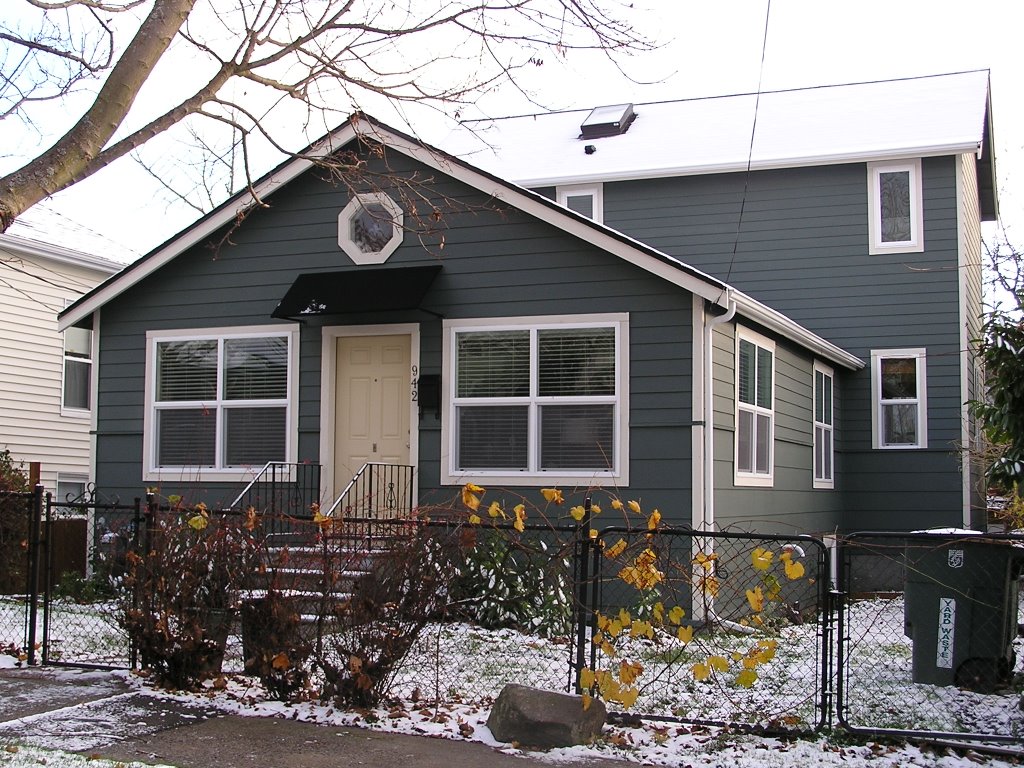
Wide shot of the house, the icy street, and Jeanne's SUV. Jeanne and Lisa are living with us and it's been fun. Their cat is here, too. Still a bit of a snit, but we're making progress every day. Xena, the Warrior Cat, ventured out into the snow today. She shook each paw after each step, attempting to shake away the cold and ice. No luck.

We're all happy today as we all have the day off. Well, Jeanne took the day off as the roads are treacherous. As a hospital administrator, she can't exactly watch the news for the message we all love -- "School Closed" -- There is no message, in fact, that says -- "Hospital Closed" -- so she checked in to make sure the day shift had arrived and that all was well.

All is well. Especially now that we are all home and safe, enjoying the cold snap of November.


We're heading up the street to pick up Lulu, the dog we borrow from time to time, and then venturing around the neighborhood on a nice jaunt. We'll see how it goes. Not much warmer than freezing right now, so I'm not sure how slick the sidewalks will be. Still, it's fun to be out in the middle of the day, in the cold when we're supposed to be at school.

Ahhhh....

Sunday, November 26, 2006

Sideways

We've broken our all-time record for rain in November. Everyone around the world thinks of Seattle and rainfall as synonomous so I'm not sure anyone will even look up from the Sunday papers to realize how much rain has fallen recently. On the year, we usually get about 38 inches of rain. This month alone we are close to, if not beyond, 14 inches already. Yes, the summer was dry and hot, but January and February of 2006 were rainy, as were March, April, and May.

And now it's coming down sideways. Sheets of it, mixed with snow. Not enough snow to stick nor enough snow to keep me from going back to work tomorrow. Too bad, though, as that means I need to grade some papers today.

But with rain falling sideways, it's hard to get motivated. I just want to curl up on the couch and solve one Sudoku puzzle after another or nap or read a book or write or bake brownies.

Unfortunately, those ungraded papers keep calling me from the corner of the room.

Where did I learn to feel such guilt? Why not just grade them during my planning time at school? Why not just allow myself to have a relaxing, stress-free, work-free vacation, which until this moment, the kind of vacation I've had?

The problem, of course, is that unfinished work piles up and instead of 2 hours worth of grading, I have 3 hours, then 4, then 8 and when it reaches that proportion, I go into panic mode, unable to sleep well or function in a way that is calm and within the optimum blood-pressure range.

Years ago, when I taught in a small town, there was a teacher I shall call Gus. Gus taught, of all things, typing, though later it was renamed "keyboarding" as we moved from electric typewriters, to computers. Granted, this was not a hard job, at least not the way Gus taught it. He'd just walk around the class saying "j j j j, space bar, f f f f" like a human metronome. Later, the kids worked off a recording and his job was simply to walk around the classroom and check the students' progress, which he rarely did. Instead, I'd see him sitting at his desk, his feet up and a newspaper or magazine resting open in his lap, reading.

School started at 7:45 in the morning. We were required by our contracts to be there by 7:15, but I usually arrived at 6:30 to prepare for the day. School ended at 2:15 and again, by contract we were required to stay until 2:45. Rarely did I get home before 5.

Gus, on the other hand, arrived promptly at 7:15 and left promptly at 2:45. On weekends, when I'd run errands and then head back home to grade papers and prepare lessons, I'd see Gus around town or out on his tractor (he owned a farm) feeding the cows or fixing a fence.

He had no papers to grade. He had no lessons to plan. He earned a living as a teacher, but he didn't have to do much to earn it. Show up to school, attend the meetings, complete report cards, which moved from hand-written reports to computer generated grading and comments. My first year of teaching it took me about 4 full days of work (usually two weekends) to fill out the labor-intensive hand-written report cards. When the computer version came along, I could whip them out in an hour, though I'd have to have entered all my assignment grades into my gradebook (also on the computer) by that time so the upfront time was just as much...only the actual report card time was reduced.

I wanted to be Gus for many years. I wanted to arrive exactly on time and leave exactly on time. I wanted my weekends free except for the work I chose (I, too, lived on a farm with sheep and llamas, and spent a fair amount of my time mending fences). I wanted to be able to be "unattached" to my place of work, emotionally uninvolved and as guilt free as Gus appeared to be. I wanted to walk up and down the aisles of my classroom watching fingers fly clumsily across the keyboards and give an evil eye to the boys in the back of class who talked during the lesson or to the girls who passed notes.

But I couldn't. I was a history teacher, then an English teacher and I felt passionate about what we studied. I wanted my students to feel passionate, too.

I know, I know this is all admirable and meaningful and the kind of teaching we all wish we had or only had on occasion, but still, I envied Gus his easy path. Hell, he wouldn't be here right now, typing furiously on his blog hoping to avert the papers in the living room that needed grading? He'd be out in the sideways rain tending to his cattle or at the cafe playing dice with the other soggy farmers. He'd be at the feed store yucking it up with the clerks, telling stories about the coldest days, the bloodiest calvings, the price of grain.

Of course, Gus retired early, too. He lost his hearing. All those years of listening to manual typewriters clickclickclick damaged his ear drums and by the time he retired, he could only hear about 30% of what he normally could.

I moved away from that small town. Away from the llamas and the sheep and the work of the farm. Away from the school where I taught about 140 kids a day. Now I teach in the city, at a private school where I work with 16 kids a day. In the old days, 140 papers would be calling from the living room. Today it's only about 30. I have my hearing. I can hear the furnace kick on and the keyboard click away and the rain hit sideways on my windows. Still, 30 papers seems like 30 too many when I'm on vacation. 30 papers feels like a crime, an insult, a burden.

I don't want to teach keyboarding. I know that for sure. But I'd certainly like to teach at a job that only required 8 hours a day.

And no guilt. I'd like a job that didn't hit my guilt button so often.

The snow is gone. It's just rain on the windows now. The downspout sounds like a faucet. The end of November. Only 3 weeks before winter break. If I don't want to be grading papers then, I should grade them now. No chance for a snow day tomorrow...

...but, if I get my papers graded today and it DOES snow, then tomorrow will be free and clear. Just me, my Sudoku puzzles, and day on the couch without guilt. Well, without too much guilt anyway.

Tuesday, November 21, 2006

The Gods are Impressed

I came home early today to meet the microwave repairman who said he'd be here by 1:30. It's now 2. Not to be discouraged, I set to work at the computer desk when lo and behold, Ms. Xena, the warrior cat jumped up to greet me. She has done this often over the past few days, feeling somehow safer to get close to me if she can be at a slightly higher level. I understand this. A huge human like myself towering over a semi-defenseless furry being would be intimidating, to say the least.

Generally, I let her rub against me and I have learned, through blood and scratches, not to reach out and make the first move. But I do coax her, trying desperately to get her to climb up on my shoulder like she does with her moms. Actually, we (Ann and I) have been so desperate, we've wagered $20 to the person who is first graced with Xena, the warrior cat on their shoulder.

So today, I'm home and working and waiting when all of the sudden, Xena, the warrior cat takes this pose on the desk...


I decided to take her picture (that's my maroon sweater in the forefront) because I'm thinking she's being so cute and affectionate...I better take this picture just in case she decides to jump on my shoulder with NO ONE HERE TO WITNESS IT!

She's actually purring in the picture and drooling, too, which is something she only does with her moms.

And then, without much coaxing from me, though I certainly was saying her name and tapping on my left shoulder (because she LOVES the left shoulder only), she did this...


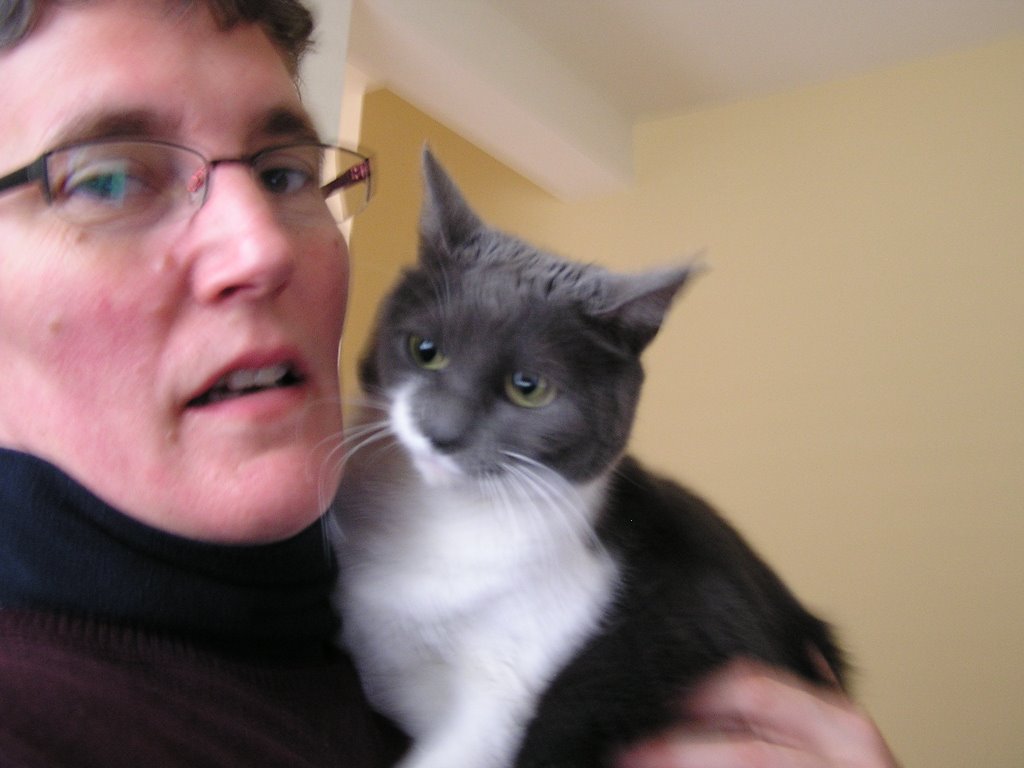
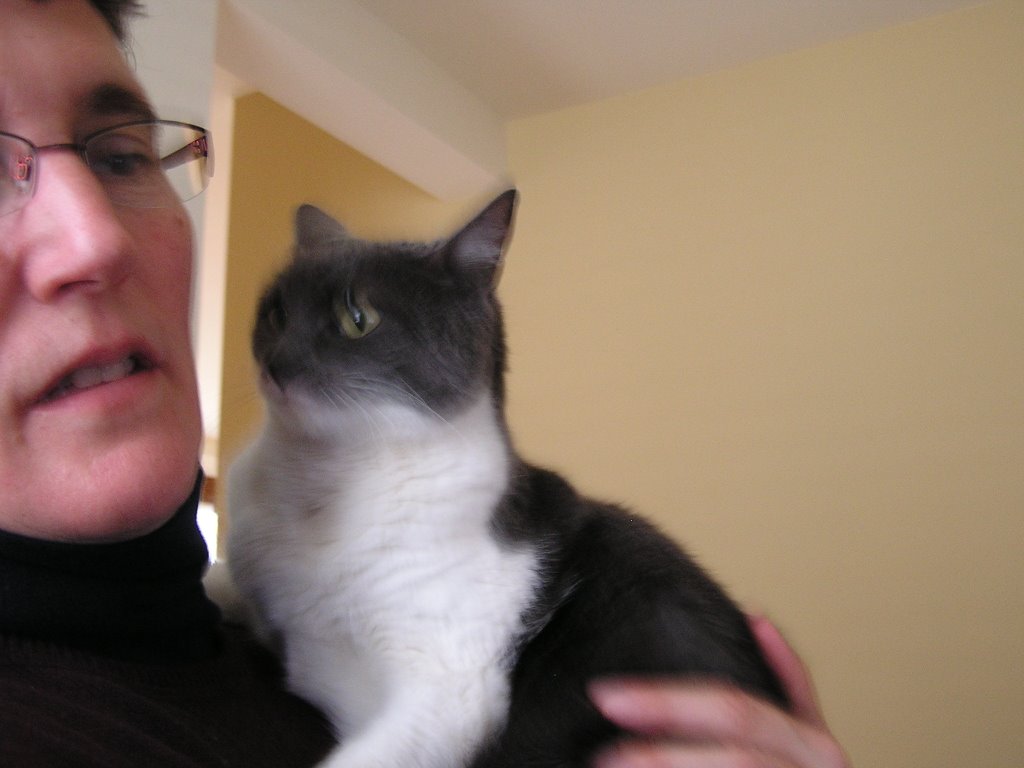
I look frantic and frankly, I was. NO ONE WAS HOME and I had to hold the cat gently, while trying to quietly and without too much jarring, reach the camera (which was thankfully on the desk), turn it on (it's Ann's camera and very different from my own so that took a moment), and then point the camera in the general direction of my shoulder and Xena, the warrior cat's face...everso close to my own!

And like most digital cameras, it took a moment for the camera to clear and prepare itself for the next picture, which was dangerously at the end of Xena, the warrior cat's patience...as you can see...


Notice, if you will, that her ears are slightly back and though blurry, you can still see her eyeballing my face.

She got down on the desk shortly thereafter, but I'm convinced it's because the skies opened up with thunderous roars and hail fell in sheets onto our roof, scaring even me.

"The god's are impressed," I said to Xena, and did a little dance in the office, the computer as my witness.

The microwave man is still not here...perhaps stuck in traffic due to the awful storm or lost in the 'hood or at Quizno's picking up a sub for lunch...who knows...but I refuse to be displeased. Xena, the warrior cat has graced my shoulder, the god's are showing their appreciation, and I am $20 richer!

Saturday, November 18, 2006

We're making progress

Xena, the Amazon Warrior cat, is still with us.

BUT...we are making progress. We can now pet her with a pencil or a newspaper, and early in the morning, when I catch her still half asleep, I can scratch the very top of her head and she almost, almost purrs.

This morning I gave her some rubs on the exact spot she likes the most, and she leaned her head back and meowed nastily again and again, but the claws stayed tucked away and her paws sat extended on the chair, relaxed and peaceful.

Last night was, perhaps, the biggest success when she rubbed against me as I worked on the computer. With her moms, she loves to extend herself on their left (yes, left) shoulders, held like a baby or perhaps a large coiled rope. At one point, while she paced the desk rubbing against my elbow, she stopped, turned, and reached her right paw to my left shoulder. Ann was standing next to me and we both gasped, "She almost got up on my shoulder!" The gasp, I think, stopped her, and she continued to pace on the desk and then, eventually, the tender moment gone, jumped down and ran into the kitchen to demand a feeding.

Progress. One paw at a time.

Although, way back in the beginning, after I'd spent a day with horses and my students, Xena actually sat, curled up and purring, in my lap. I think she was attracted more to the smell of horses than to my open hearted attempts to love her, but still, progress can come in many forms however deceptive they may first appear.

Friday, November 10, 2006

Warrior Princess

Our friends are remodeling their house. Currently, they are house-sitting and cannot keep their cat at their new location. So we agreed to watch her for them.

Her name is Xena, like the Amazon warrior princess television show with Lucy Lawless in the starring role.

The cat Xena is as deadly as the Amazon fighter.

Small in stature, she is a gray and white, short-haired killer. She screams her meows if we get too close. She hunches behind blind corners and on the edges of hidden counters, then whips out a claw-extended paw to swipe tracks across our arms and legs. She teases us, rubbing lovingly up against our shins, weaving in and out between our legs, her tail straight up and quivering. We've learned not to take the bait only after she's snatched our whole hand in her mouth and chomped as hard as a pit bull.

The first week at our house she refused to eat or drink. We checked her cat box every day for signs of elimination only to find nothing, nada, zilch. Worried, we got her some canned cat food and once she heard the snap of the metal lid, she became obsessed with the smell, chasing us through the kitchen to make certain we were putting the gooey wet stuff in her bowl.

Now!

Soon, every time we were in the kitchen making cooking sounds, she was on top of us, demanding a taste of the refried beans, the tomato sauce, and even the mild chili peppers used to make enchiladas, hoping for wet, smelly cat food.

She understands our words, too. "I'm going downstairs," Ann will say and soon the cat will be perched on the bottom step, guarding the passageway with her teeth and claws, hissing and spitting as if being attacked by a dog.

"I need to find my water bottle," I said the other morning and the moment I spotted it, Xena spotted it too and raced to the bottle to rub her sleek body against it. The closer I got to the bottle, the more agitated she became, stomping her back feet as if beating the war drum of the floor.

I went into the kitchen and used a different water bottle.

She sleeps up high -- the back of the couch in the living room, the top of the highest cupboard in the kitchen, the tall corner of the cabinet in the family room. Half the time we don't even know she's around until one of us screams or gasps or jumps back quickly, avoiding a scratch or a bite or a deadly warning hiss.

Her mothers come to visit her every other day. Xena transforms into a real cat then, purring softly, leaping up into the arms of one mother or the other. They pet her, coo softly into her ear, stroke her soft fur, rub the rough spot between her ears. They cradle her in their arms and Xena lies flat on her back, her once deadly claws straight in the air, clawless and loving.

We can pet Xena then, when she is distracted by her mother, but once Xena realizes there are another set of hands stroking her back, she turns like a viper and spits her discomfort. Then, when Jeanne and Lisa leave to go back to their house-sitting job, Xena grumbles and groans, moans and meows in her sickening, mass-murderer voice, stomping around the house as if possessed by demons. Pissed.

I am hard-pressed to believe she is not possessed.

I consider myself to be an animal person. Every animal I have ever met comes to me willingly, rubs against my legs or leans against me for a scratch under the chin. Xena is a mystery. I want to understand her. I want to get close to her.

Dare I say, she epitomizes my life-long struggle -- I want her to LIKE me.

But aside from canned food and affection from her mothers, there is little Xena likes. She walks through her life grumpy and irritable. She looks for a fight. She likes the taste of blood. She rarely relaxes and when she does, it is usually when she curls up deep in the chair, blending in with the wool throw on the couch or the chair.

Like a snake.

Jeanne and Lisa call us every day. "How's she doing?" they'll ask, which is immediately followed by, "You two are saints."

"It's really fine," we'll say. "We want to help out and she's really no problem."

Then everyone laughs because we all know, she's not a problem.

She's a warrior princess, her claws a battle axe, her teeth a mace, her hissing a battle cry. Defender of inner demons.


Xena stalking the kitchen counters.

Wednesday, November 08, 2006

Election Thought

I wish there was a "West Wing" reality show right now. Nancy and George at lunch. That would be a fun script to write.

Sigh.

Tuesday, October 31, 2006

Dichotomous Celebration

In my 5th grade classroom, we're studying classification systems. The students are learning all about Carl Linnaeus and big words like taxonomy and phylum. We started the lesson with shoes, classifying the student's shoes into a hierarchy from their Kingdom (they're all shoes) to their Phylum, Class, Order, Family and then finally, to the exact Genus and Species of each shoe -- they're red Nikes with pink laces, or as we came to name them, Pinkosis nikiderma.

Next, we introduced dichotomous keys -- the classification system that does exactly what its name implies -- divides things into twos. Again, we used shoes. We divided our shoes into those with laces and those without. Then we divided the without laces pile into those with leather and those without. Next we divided the without leather into white and not white shoes until eventually, working our way through all the divided piles, we ended up with 16 different types of shoes to match the 16 different students each with their own name and distinguishing features and characteristic.

"It's all about the name," I told them. "It's how we make sense of the world around us. We name it and the name becomes the thing and the thing then becomes the name. An individual. Unique and beautiful."

I like dichotomous keys. They make sense to me. Something is either this or its not, no middle ground, no ifs ands or buts. It is this or it isn't. A plant either flowers or it doesn't. A animal either has feathers or it doesn't. It's kind of like a puzzle, one concrete detail after the next until you end up at the thing itself, named and solid and uniquely it's own entity.

I think a dichotomous key would be handy for a person like myself who is gay, but who lacks "gay-dar" -- the ability to spot another gay person simply by their appearance or perhaps their energy.

I'm not sure why my gay-dar never developed or if I even had it at all, but I've always struggled with "knowing" if someone is or isn't like me -- in the same Family, so to speak.

That's why I think those of us who are "gay-dar impaired" should create a dichotomous key (or perhaps it could be called a "dyke" -chotomous key) -- a handy chart for identifying if you are or aren't gay or lesbian.

The chart might look something like this:

Two columns with separate headings -- Lesbian versus Not-Lesbian

On the Lesbian side the division would continue -- Owns a Truck; Does not own a Truck (that would be me...though it's an SUV and close to a truck)...followed by Owns a Large Dog; Does not own a Large dog.

Here's where the fluidity of the key would get interesting. I once was a lesbian with truck and a dog and now I'm a lesbian sans truck and no dog (though one is destined for my future). The usefulness of the key would be that you could flip from one side of the dichotomy to the other and still, in fact, stay on the Lesbian side. Your sexual identity would not change though your attributes would -- like a tulip that lost its leaves is still, according to the key, a tulip.

But I digress.

Continuing on, the chart would reflect other stereotypical markers --Androgynous/Non-androgynous; Short Hair/ Not Short Hair; Vests/No Vests; Fleece/No Fleece; Softball player/Not a Softball Player; Carharts/No Carharts -- until you get down to the finest details that would distinguish ME as an individual lesbian -- unique and beautiful -- but still, in essence, a lesbian.

For instance, Lesbian with Children/Lesbian without Children. At a time when lesbians and gay men are reproducing (however oxymoronic that may sound) as fast as rabbits, this category winnows out whole groups of lesbians who must now be distinguished by something other than their offspring or adopted offspring.

And so I continue: Married/Not Married; Job in the Trades/No Job in the Trades; Fashion Sense/No Fashion Sense (an important distinguishing feature in the lesbian community and perhaps even in the gay community...though maybe not so much as I've rarely met a gay-man who didn't have a fashion sense or act as if he did); Decorating Sense/No Decorating Sense (similar to Fashion Sense -- it distinguishes the Lesbians who live in purple houses with green trim from those who don't). Vegetarian/Non-vegetarian -- which can be further split into Vegan/Not Vegan.

Cultural Divisions -- Indigo Girls Music Collection/No Indigo Girls; Theater-going/Non-theater-going; Opera season ticket holder/Non-Opera season ticket holder; WNBA season ticket holder/Non-WNBA season ticket holder.

Political divisions are important as well: Democrats/Not Democrats; Radical Feminists/Not Radical Feminists, which leads right into religious distinctions -- Religious/Not Religious; Traditional Faiths/Non- Traditional Faiths from which many further divisions can be made -- Woo-woo beliefs (like Wiccan or New Age)/Non-woo-woo beliefs (like Catholics and Baptists).

I could go on, but the idea would be to sell these little Field Guides -- small hand-held books or maybe even small handheld electronic versions -- that let you calculate your observations, work your way through the key, until you figured out that yes, that woman in the short skirt wearing make-up and high heeled shoes is really a lesbian (of the category non-androgynous, long- haired, non-softball playing, truck-owning variety).

Such a key would not only help gay people like me who suffer from gay-dar dysfunction, but it might help straight people avoid embarrassing situations like the ones I've experienced:

Example#1
I'm at the University Bookstore. It's summer. It's 90 degrees outside and I am in shorts and a tank top, sandals on my feet. I walk into the restroom and a woman, who is just opening the door to come out as I'm pushing the door to go in, stops in her tracks and says, "You can't come in here! This is the woman's restroom!"

I have very broad shoulders. I have short hair. Sometimes I shave my legs, but mostly I don't. I have long hair on my legs. It's dark hair. I have muscles. I am tall. I wear tank tops that have room in them, not tight-fitting spaghetti strapped numbers that look more like underwear than shirts. My shorts are baggy-ish and the hem hits just above my knees. I can see how she'd make the mistake, glancing merely at the features that say man, not man. I fell into the category of man in her eyes and all else was disregarded -- my breasts for one, my earrings (though that doesn't always help) for another.

If she'd had a handy-dandy hand-held key, she could hold up the device, have it scan me and then say, "Have a nice day, sweetie" instead of insulting me with her ignorance.

Or

Example #2
I'm meeting prospective families at our school's open house. We call it Wooing Night and our job is to charm parents into sending there kids to our school. I'm talking with a mother of a precocious 4th grader who interrupts our conversation by twirling on her mother's arm.

"I see you're married," the mother says, pointing to my wedding ring.

"Yes, I am," I say, avoiding the details.

"What work does your husband do?" she presses on.

"I don't have a husband," I say, "but my partner teaches fourth grade."

Wedding Ring - No Wedding Ring; Husband - No Husband -- it would only take seconds for the prospective parent to assess me and then avoid my frustration and anger that I must, yet again, question the dominant culture's assumptions of me.

Of course, we'd have to include the category of Likes Labels/Doesn't Like Labels, but even the non-label-lovers could see the value of such a key I would think. Not only would people know you better, but maybe then all the negatives and bigotry that come from assuming they KNOW your labels would end.

It's all in the name, I say -- we name the world to understand it. How much happier we might all be if we could just take the guessing out of it.

Lesbionic specialous. A rare, yet beautiful flower.

Sunday, October 15, 2006

Rivers and Reflections: The need for eddies in education


I've just returned from a writing retreat at the Environmental Learning Center in the North Cascades. A beautiful setting, amazing weather, and three very different, but equally talented writers/instructors.

I have many thoughts about the retreat, which I'm certain I will write about over the course of the next few weeks, but today I find the rain particularly pleasant after a week of sunshine and mountains, lakes and fall colors.

When I woke last night to the sound of rain on our new roof, I was thankful for Ann lying next to me. Her rhythmic breathing provided a gentle back-beat to the softness of the rain and I curled up in my pillows relishing restful sleep.

The writing retreat was a mixture of awkwardness and reflection for me. I always have a hard time trying to fit into these events, searching for people with whom I can find alliance in political as well as emotional perspectives. Of course, at a nature writing retreat environmentalists are in abundance and I doubt there was a Republican among us. If there was, s/he was probably feeling more awkward than I was throughout the week.

My awkwardness stems from many things: Lack of confidence in my writing, in who I am as a person, in an inability to feel comfortable in social situations, and the need to know that I am liked and accepted by those around me. I battle it wherever I go, but this week it took me longer to figure out my place in this world of nature writers.

I don't see myself as a nature writer per se. Yes, I write of human nature and being in a wilderness setting makes me far more reflective than I am in the city, and preserving nature IS extremely important to me, but I don't see myself learning the names of plants and trees so that I might incorporate it into my writing. Still, it was exactly what I needed this week -- clean air, blue skies, water and mountains.

It is, perhaps, a need for reflection that nature provides me. My life is busy with teaching and all the whirlwinds that surround my work. We were asked, before I left, to call all of our students' families, to check in and see how they were feeling about the school and their daughters' experiences. I resisted making those phone calls for many reasons, and in the end, I didn't get around to it. During the week, the Dean of Faculty was going to call me and ask me to make the phone calls from my writing retreat. Luckily, my teaching partner stepped in and not only prevented the Dean from calling me, but took it upon herself to make the calls.

Finding this out made me realize how often my time for reflection is interrupted by obligation and soon I am caught up in completing this task and that, filling my time with a long list of jobs I must complete before I permit myself to just sit and reflect. Often that permission never comes.

And then I think about what lessons we are teaching the girls. When they see us run around and frazzle our way through a day, what message are we sending them? To do is more important than to rest? A full plate makes your life more meaningful than one filled with select and thoughtful choices?

Often I hear students claim that they are bored. More and more I'm thinking it isn't about boredom, it's about not being comfortable with reflection, with one's own thoughts, with the fullness of our own presence in the world. Perhaps that is what I was feeling at the beginning of this week -- an uncomfortableness with myself not being busy, not having a task to complete, not having an obligation other than the ones I made for myself.

I was never bored. I've learned over the years that boredom is an excuse more than a state of mind, but I often found myself stymied by what to do next. Write? Read? Hike? Nap? Find someone to talk with? I moved sporadically through the empty times when we were not required to be in a workshop or a lecture. I found it difficult to ground myself within the time where I was without obligation.

Eventually, a rhythm developed and I often chose to be alone, on a hike or by the lake reflecting or writing, reading or unintentionally meditating with my eyes closed to the October sun. When I got back home yesterday, Ann was out with our friends. She left a note telling me when she'd return and while I was disappointed she wasn't here to greet me, I was thankful that my re-entry into the city didn't require too many expectations.

I made the mistake, though, of checking my school email where about 70 messages slapped me with the reality of my work. There were meetings and parent communications, there were announcements about workshops and contacts from community partners with questions about upcoming field trips. I couldn't read them all. I scanned, only stopping at the ones I thought might be of interest.

During the writer's retreat, we sat by (and in) a creek during one workshop. We were asked to sit quietly with our eyes closed and just listen. The water was icy on my feet, the filtered sun made patterns on my closed eyelids, and the wind moved the trees where chattering squirrels scolded us. I loved the sound of the water and soon found myself opening my eyes to watch the creek carry the water along channels of moss-covered rocks, over submerged logs, and down into swirling eddies lined with yellow and brown leaves.

Water in a creek moves constantly, but unlike my work, it rests along the way. It pools behind boulders, it moves upstream and then back down slowly into an eddy until finally the pull of the creek gathers it back into a push downstream. This is what I wish for in my work life. I am not afraid to move downstream. I am not afraid to push and roar and even thunder, but I need the eddies, too. I need the time to swirl and turn, to be caught in relaxing -- where the sun can catch me, where detritus can collect, where I can wait for the stream to pull me back in and push me on over the next rocky length.

This then is my charge. To carve out my eddies of reflection. To model such rest and contemplation for my students. To help them see that boredom is an invitation to feel one's presence in the flow of the world. In it's light. In it's reflection. It is, at times, dark and twisting, but more than anything, it is necessary. The eddy is as important to the creek as the rapid water over smooth, time-worn rocks.

Tuesday, October 03, 2006

My Footprint


For the past three months now, The Sun magazine has sent me postcards and letters and extra wrappings on my magazine warning me that my subscription is about to run out.

Today it did. I received my copy in this afternoon's mail along with 3 catalogues, 2 coupon flyers, and another letter from The Sun magazine telling me this is it.

I'm torn. I really love the magazine -- the beautiful photography, the thoughtful writing, the ad-free pages -- but I'm also trying to "simplify", which may see odd as we just finished remodeling our house, adding 950 square feet to our existing 640 square feet.

I'm torn because I'm trying to reduce my "ecological footprint" or the impact I have on the environment. This was of great consideration when we remodeled. "Green" homes, or homes that are environmentally friendly get ratings. 5 stars is the highest rating a green home can get. We have 4. We didn't have the money for a gray-water system or solar panels, but everything else meets the environmentally friendly code.

While our house is bigger, it's by no means extravagant. In fact, the cover of a magazine I saw in the grocery store exclaimed, "How to live in small spaces: 1700 square feet or less." Wow, we lived in 640 square feet for 4 years and in an attempt to "save" the house (built in the 1900s) we remodeled and now live in 1590 square feet. The new house just built on the corner last year boasts a whopping 3500 square feet and the house up the street called the "ghetto mansion" by the locals is 6000 square feet. What would one do with all of that space? Fill it up with magazines?

We also own only one car. Granted, it's a SUV, but we drive it minimally and both of us either ride our bikes to work or I generally walk to work while Ann carpools with a teacher-friend.

We keep our heat at 65 degrees and I challenged myself this year to not turn it on until October 1. We made it until today (October 3) because it is colder than 65 degrees outside and the house has a chill. Still, 65 degrees is pretty good and since we're gone most of the day, it only comes on for a few hours in the evening.

We compost our food scraps, we recycle religiously, and all and all, we really don't overconsume with purchases (though we have had to buy more furniture for our now larger house).

We buy organic with fresh vegetables and fruit delievered to our door every other week and a trip to the local farmer's market when we need extras. And yes, we ride our bikes to market.

Truly, we live mindfully, but the decision to re-up my subscription to The Sun was a tough one for me. Yes, I like the magazine, but it feels like an indulgence. I could just get on my bike and pedal to the library four blocks away (or walk, for that matter) and read the monthly magazine there.

While the magazine boasts of no ads, every month they sent me a card in the mail urging me to get my friends to subscribe or offering me a chance to resubscribe early at a slightly reduced rate.

That's a lot of paper. That's a lot of energy.

My mother has a list at home of all the catalogues she receives. Diligently, and only as my mother could, she has called the various businesses who send her these catalogues and asked the companies to stop sending them. By each catalogue name on the list is the phone number of their customer service office and little check marks tallying the number of times she's had to call them.

Some checks go on for quite awhile.

If I wanted to save paper, I could do the same...call all the companies who send me catalogues and tell them to knock it off, but when I look at my mother's efforts, I get discouraged. I don't have that kind of time to call and complain. (Not that my mother does, the busy Democrat that she is!) Instead, it's easier not to resubscribe.

So, I decided last month that I would not renew my subscription and when the last one arrived today, I read the article by Bill McKibben and had to chuckle. His article, entitled "Dream A Little Dream," is about reforming our supersized society, about considering the costs to our planet of overconsumption.

He writes: "The Achilles' heel of consumer society is that it hasn't made us as happy as it promised it would. Although Americans have tripled their prosperity since the mid-1950s, the percentage who say they're 'very satisfied' with their lives has declined...We've pursued the American Dream to no real apparent end."

He goes on to talk about global warming and the shift away from farming to technology and gluttonous consumption.

I love reading this. I love hearing someone say what needs to be said, but when I hold the recycled paper of the magazine in my hands, I feel that thin line between hypocrisy and conviction and cringe a bit.

Recycled paper is better than non-recycled, but still, the energy it takes to recycle it, the energy it takes to send out little postcards every month or a letter reminding me that my subscription is almost gone is immense.

Yet, here is my dilemma: If I do not subscribe to the magazine, they will lose money. If they lose money, the may not be able to publish their magazine. While the loss of Newsweek or Time or those ghastly rags at the checkout stand would be an actual blessing, the loss of the information published in The Sun would be devastating...or the loss of Mother Jones or even the now trendy and woo-woo-fied Utne Reader.

Still, it feels dishonest to me to be reading an article about reducing my consumption in a magazine I pay to consume...in a magazine that consumes resources...in a magazine that uses energy to consume resources.

But then I think about how many other people subscribe to The Sun and Mother Jones and The Atlantic Monthly, and all those other people who subscribe to Newsweek and Time, or worse, People. Will my cancelling a subscription to one magazine make a difference?

Now you see the quandary. How does one live simply in such a complex puzzle of American society?

I guess it's by one magazine at a time.

Friday, September 29, 2006

On Breathing


Driving behind the ambulance at 1o:30 last night, I was thinking about all the things I miss living back in the city. First and foremost, I miss the stars. Even as we wound our way through the black mountain highway, the ambulance lights flashing in panic in front of me, I could see stars in the darkness overhead. Millions of stars. Billions of stars. "Do you think we'll get to see a star supernova?" a student asked me the night before. "Possibly," I answered skeptically.

But a supernova didn't really matter. What mattered right then, right when I found myself looking up more than following the road, was that billions of stars were out there even if I couldn't see them most nights of my life.

These past few days we've spent with our 5th grade class of girls at the North Cascades Institute's Mountain School, living in eco-friendly lodges, spending our days out on the trails studying the ecosystems, and enjoying nightly campfires while mosquitoes nibbled our exposed ankles. Spending three days in the mountains reminded me of all those bits in my life that have vanished with city living.

Stars among them.

Tall trees, too.

Once the ambulance shut off its lights, the trees surrounded me in a shadow of blackness that felt mesmerizing, comforting. At night at the Institute, after all the girls were fast asleep, I'd step out onto the patio of our lodge and look out to the wall of trees nestled around the feet of the magnificent peaks -- Pyramid, Colonial, and even Sauk mountain to the south. Some people say trees talk to each other, but in the mountains the trees talk to god.

But as I drove the winding road down to the hospital an hour and a half away I grew sleepy, despite the surging adreniline of just a few hours before. With my windows rolled down, I hung my head out into the night and smelled the thing I miss most about not living in the country -- the air. Mountain air. Rich. Almost heavy. The smell of dirt and heat rising from the soil and feathers and leaves and distant snow from mountainous rocks. I breathed it in again and again, willing myself awake, willing myself to stay a safe distance from the ambulance at the same time not lose myself to the stars and the trees and the fresh mountain air channelling through the car.

Millie wasn't breathing. Early that evening, Millie panicked, began to sob, hyperventilated, and the air, thick with memory, choked her every breath. We stroked her back and hands. We spoke softly and tenderly to calm her 10-year old anxiety. We wiped her tears and her snot and practiced breathing with her -- deep breaths in, deep breaths out -- but still, she gagged. She gagged on the air, on the tears, on the thought of not being able to take the next breath.

We tried a paper bag. We tried her inhaler. We tried lying her down and standing her up. We carried her to the sick bed at the camp office. We gave her oxygen. And still, each breath was stalled, blocked, prevented from filling her lungs.

We called 911. We called Millie's mother.

When the ambulance arrived, we had made our plan. I was to drive behind the ambulance carrying Millie. M., my teaching partner, and S. our other chaperone would stay behind with the girls and return, as scheduled, today. The drive to the hospital was about 70 miles along mountain roads narrow and dark. Halfway through our journey, we'd change over to another ambulance equipped with well-trained EMT's and one that could carry us all the way to the hospital.

By the time we arrived at the hospital around 11:30 p.m., Millie was breathing on her own, able to inhale her medication just enough to calm her down. I sat with her in the ER, holding her small hand and listening to the doctor talk to her about panic and anxiety and how not breathing is a vicious cycle. A sheep in wolf's clothing he called it. Much worse than it appears. A scary wolf on the outside, but just a simple sheep on the inside.

Millie understood little of his metaphor and when her mother arrived, she asked if she could go back to camp to be with her friends. Her mother laughed and looked to me. "Sorry," I said, "But once you leave in an ambulance, you can't go back until the next time."

"But they'll be no next time," Millie moaned.

"It will always be there," I try to console her. "Perhaps you can go back with your mother this spring."

But I knew that wouldn't be the same. There would be the blossoming mountain air, the budding conifers, and even more stars, but she'd be without her friends, her class, the experience of being on the mountain trail with 15 other singing 10 year olds.

At midnight, I left Millie and her mom in the hands of the doctors and the paperwork and stepped out into the parking lot trying to decide my next move. I couldn't drive back because I did not have the key to open the gate that let me drive across the dam to the other side of Diablo Lake whose shores were the home to the camp. I could check into a hotel and drive back up the mountain pass in the morning. Or, as my teaching partner encouraged, I could drive for another hour+ home to my own bed, to Ann, back to the city.

The hospital parking lot was full. An ambulance pulled into its bay and unloaded another sick patient. A young Native American man and his family sat on the curb waiting for their ride, the man's head recently stitched up, his shirt soaked in blood. He smoked furiously, his puffs curling up to the flattened stars above. He swore, he bleched again and again, he spat on the ground while a woman (sister? girlfriend?) talked on her cell phone next to him and another man (brother? friend? father?) sucked down one Coke after another, a six pack propped up next to him. The man glared at me, angry and agitated, and I lifted my chin to the stars. "Beautiful night," I nodded. "Fuck you," he mumbled.

I called Ann, opting to go home, slightly worried she'd be upset that I'd called so late. "Hello, honey," I said.

"Oh hi," she sang softly, "Are you homesick for me?"

I laughed.

Yes, I thought, just as I am homesick for the stars and the trees, and for the air we take for granted.

"I'm coming home," I sighed and then told her briefly about the events of the evening.

By the time I walked through the front door of our home, I was acclimated back to city lights and city smog and actually happy to see the maple trees that line our street. I crawled into bed and Ann snuggled up to me, warm and soft, her familiar breath against my neck.

In two weeks I'm heading back to the Institute for a writing conference, this time without students, without the responsibility for the breaths of 10 year olds. "I wish I could bottle up the air," I told Ann this morning. "I wish I could just take a slice of that wilderness and bottle it up to ground myself during the stressful times."

She smiled and kissed me on the cheek. "Remember your happy place," she suggested, referring to our recent commitment to meditate on those places where we feel at peace when our work overwhelms us.

"You'd be in that bottle, too," I told her. "You smell as good as the trees and the water and the stars." And then I sighed, one deep breath in, one deep breath out. Grounded.

Monday, September 25, 2006

Chunk o' change

I just received my Social Security statement. Intriguing points.
1. I made $11,000 less in 2005 than I did in 2004.
2. In my first job ever, way back in 1976, I made $340
3. If I wait until I'm 70 to retire, I can earn $2,201 a month
4. BUT, if I have an accident right now, I can earn $1,666 a month (note the 666)
5. In 30 years of working (messenger, bike mechanic, TV crew, and teaching) the difference between the least I earned and the most I've earned is $63,000. Seems, at first blush, a hefty sum...but then I think, I wonder what Bill Gate's SS statement looks like or Oprah's?

The gap between rich and poor -- evident and all relative, I guess.

And I think to myself, do I need more money? Honestly, no, but there feels like an injustice somewhere along the way and I just can't put my finger on it...

Okay, I've got it...I was just listening to the news. The armed forces are asking for $120 billion to "update" the military effort on the "two fronts." A General who was interviewed said it was time that we decide if we're going to have a well-trained and well-equipped ground force for generations to come.

As a teacher I ask -- isn't it about time that we have a well-trained and well-equipped citizenry?

Oh what a well-placed billion could do...

My two favorite bumper stickers to date:

If nothing changes, nothing changes!

And

I want a president who talks gooder.

Let's go to war on a third front, then we shan't have to worry about educating anyone! Shoot first, and we'll ask questions...NEVER!

Somewhere in this rant is the injustice I can't seem to put my finger on...

Sunday, September 24, 2006

Dogs in My Life


Monty, the cross-eyed Standard Poodle. And the enormous long-haired Shepard, Ben. Two weekends ago, Monty stayed with his while his human-mom went to a wedding in Spokane. For the last month of our remodel, we lived with Ben and his human parents in a large house on Lake Washington. Ann and I are not ready for a new dog in our lives, so we borrow the dogs of our friends. Last night, we took Ben for a long walk along the Lake and every morning, we see Monty and his human mom on their morning constitution.

"I think someday," I told Ann last night, "we will get tired of borrowing dogs and want one of our own."

"Yes," she said, "But for now, I like borrowing."

This is because we only have temporary obligation to feed, water, and walk the dogs. This is because we both still dream about Chester. This is because we want to try living our lives without having to worry about who will take care of the dog if we travel or go skiing or stay out late at a concert. This is because Chester's long illness and death exhausted us and we are just now figuring out how difficult that was on us. This is because we still think Chester cannot be replaced or that our love for a dog can encompass another dog the way it encompassed Chester. This is because Chester is still every other beat of our hearts.

I had another dog, Abbie, who I loved as much as Chester. In fact, one of the reasons I liked Ann so much on our first few dates is that she had a dog that looked a lot like Abbie. Of course, the more I got to know Chester, the more he didn't resemble Abbie at all, but I do think Abbie was saying, from wherever she is, "This is a good dog" and so I let myself love Chester as much as I loved her.

I still dream about Abbie, but often in those dreams she morphs into Chester. I still miss Abbie -- her smile, the way she greeted me with happy moans, the way she rolled over on her belly to get rubbed. Chester did none of those things. Well, he smiled, but differently than Abbie. But he rarely barked, rarely made noises, and never once did I see him roll over to show his belly.

But the pain of Abbie's death has faded. Now I just remember her happy and the romps we'd take to the beach or the woods, but none of the sadness of her death (I had to put her down too because of her bad back...she was in horrible pain...both she and Chester lived to be 14). I know that someday I'll feel the same about Chester -- the fun memories will replace the painful ones, but for now, I still cry early in the morning when I cannot hear the sound of his waking up, or at night, when I cannot hear the heavy sigh that signaled his saunter into dreamland.

Sometimes, when I dream about him, I can feel the weight of him pushed up against the back of my legs or around my belly -- the places he liked to sleep the most -- and I wake half believing he'll be there only to feel the sunken feeling of his absence all over again.

It's not horrible. It's not like those first few weeks when crying is what I did more than not. It's just on occasion that the feeling of missing him wells up and I have to go borrow a dog, like Monty or Ben.

Or Lulu....
...the other neighbor's dog who we will be walking in the afternoons now that her mom is back at work and the daughter has gone back to college.

It's good to have a dog in our lives, if only part time.

And someday, it will be full time...when we get tired of borrowing...when we can't feel the weight of Chester on our hearts as deeply as we feel it now.

Thursday, September 21, 2006

Netflix


I gave in. I signed us up for Netflix. I'm tired of another episode of Law and Order though now the reruns are ones I've not seen. It's surprising how many I haven't seen since there are some I've watched four or five times. I'm tittering on becoming a TV junkie again, but I'm trying to fight the urge...hence, Netflix.

The first DVD we rented was "Rivers and Tides", the documentary about artist Andy Goldsworthy. It was interesting. It was slow, but after spending our days with pre-adolescent children who ask a billion questions and demand our instant attention, slow was good. Slow was relaxing.

And just when I was really getting into the movie, it got stuck...froze, as DVDs tend to do in our DVD player. At least I think it's because of our DVD player. We once watched DVDs on a really expensive player and the disc froze then, too, so who knows why it does that, but it did it right at the end of Rivers and Tides and well, it kind of ruined the relaxed instrospective mood.

Still.

That sense of introspection stayed with me throughout the week especially after my Dean of Faculty confidentially informed me she was looking elsewhere for work (she doesn't make enough money as a single mom to support her two kids). Ironically, she can make about $25,000 more as an administrator in public schools. Which got me to thinking...how much could I make if I moved back to public school? I compared my current salary with Ann's public school pay scale and I was shocked that I could make $13,000 more.

It was enticing...but only briefly. Middle school teaching in the public arena means 125+ kids, 6 periods a day, and very little collaboration with colleagues. Students aren't as motivated as my private school kids and then there's all of those administrative headaches. Plus all the things we can't do, like field trips and integration of curriculum and having an actual conversation with every parent of every kid in my class.

Is that worth $13,000? Probably not, but I make enough...I don't need more. Yes, I'd like more, but I don't need more.

Yet when I found out that our Dean was working on leaving, I cried. I really like her. I really appreciate all the work she's done to get us organized and moving forward. She understands education. She sees the big picture. She's reasonable. She listens. She's helpful.

I cried for many reasons, but one of the compounding factors is that my teaching partner is also trying to leave for the very same reasons...money.

Here's where the introspection turned a darker shade.

The last time I struggled with depression, I came to understand that it was triggered by loss -- my dog had died, my teaching partner at the time took ill and left teaching leaving me to make a huge career decision, I'd had serious back surgery that limited my athletic abilities, I'd turned 40...blah, blah, blah.

Little red flags go off when I start to see the losses pile up, like cars on the freeway. Red flag -- Chester dying. Red flag -- struggle with my long-time friends (which is better, but still feels awkward). Red flag -- my teaching partner is going to leave. Red flag -- the Dean (who I consider one of my anchors) might leave.

I check myself each morning -- where's the darkness? How far away? How close? Can I touch it? Is it in me? Is it hanging over me? I measure my anger...is it reasonable, is it rational, is it justified? I count my tears -- what time of the month is it, is this menopause or is this depression? I watch for cynism-- is there a reason for it, is it coming out of my mouth at a constant rate?

It's like radar, beeping silently atop some unmanned lighthouse. How close am I to crashing onto the rocks?

Not close. I know I'm really not that close, but once you've crashed your vessel, the dangers seem much closer to the surface, much more threatening then they actually may be. If the captain of the Titanic knew when he set sail what he knew the second his ship hit the ice, would he have made different decisions?

Probably.

So I walk around with this darkness monitor, observing the needle as it lifts up when I find that two people I really like working with are going to leave eventually and wondering, will the needle stick, will the needle keep rising? Or will it ease back down, slide enough into the light that I can sleep peacefully at night?

It may seem like a stretch, but these are the real reasons I signed us up for Netflix. I don't want to be a TV junkie watching Law and Order episodes to the point where I can recite the dialogue. I want to watch Andy Goldsworthy build these incredible rock cones that tumble into heaps before he has time to finish them. I want to hear him say, "That's the way of understanding -- seeing something that was always there but you were blind to it."

That's how I feel about living with depression. Those threatening rocks on the jetty. Those dangers just beneath the surface the lighthouse keeps trying to warn me from.

It's always there...it's just now, I'm no longer blind to it.