An hour before the wedding it rained. Not a heavy rain, but the misty kind of rain that soaks everything in a matter of moments. The kind of misty rain that rests soggy on your hair so that when you shake your head, you look like a sprinkler.
I know this because we were walking the dogs before we dressed for the early evening wedding.
"I wonder if they'll move the wedding indoors?" I asked Ann as the rain dripped off my baseball cap.
"Hard to say," she laughed slightly. Ann does not worry. Even though it was not my wedding, I worried about the rain. It seemed like potential chaos to move 100 people from outdoors inside especially after so many months of planning and gardening.
The color theme of the wedding was, of all things, black and white. This gave me a couple of options for attire, but none felt right. This is always my struggle: How to feel like me in clothes that don't feel like me? Which begs to question why I bought them in the first place, but I think it has to do with the particular situation matching my particular clothes.
Remember, I don't usually go to weddings so my closet isn't filled with wedding options. Instead, I have a closet of work clothes and sweaters, khaki pants and fleece (a requirement for every good Pacific Northwestern lesbian).
So, while I liked my black pants and I even liked the rather low-cut muslin white shirt I wasn't quite sure they were wedding-proper. Still, this is what I chose to wear after tossing out the light blue shirt with the black pants, the blousy purple tencil shirt with the black pants, and the simple black t-shirt with the black pants. I suppose if I'd had a black skirt in my closet that would have all worked with any of the above shirts, but alas, I haven't had a black skirt in my closet since I was 9 and even then I can't be quite sure if I owned a skirt at all.
Once dressed, we pondered the dogs. Despite the walk with the dogs, only Rubin did his business. Ben, reluctant and nervous, had yet to pee even after a bowl of water and already a few hours at our house. We needed to pen him during the wedding and I worried that, after NOT peeing, Ben might decide to do so some other way.
Let me back up a bit. Ben is huge. When people see us walking down the street they often gasp. I'm not making this up. His head is large and his body stately and incredibly long. Older women with small dogs are known to cross the street fearing the large beast they see before them will attack, but Ben does not attack, at least not unless he is continuously and persistently provoked. And even then his attack is a loud bark.
Rubin tried on a number of occasions to provoke him. He'd fling his 25 pound curly body into Ben's back end punching his nose playful in every attempt to get Ben to play. But Ben only plays fetch and only with humans. He avoids other dogs. Goes out of his way to steer clear of them and despite Rubin's taunting, Ben refused to budge. Instead, he'd snarl a bit and then walk away locating the nearest human behind whom he could hide.
I've come to realize that Ben does not think he's a dog. I'm not sure what he thinks himself to be, but it is not a dog. So I worried that penning Ben up for three to four hours while we attended a wedding might lead to him pushing his crate halfway across the new bamboo floors in an attempt to get outside. He's clever that way. At one point in the afternoon, he found himself in the front yard where I caught him shoving his nose against the gate latch in an attempt to open it. I caught him just in time so I wouldn't put it past him to figure out a way to open the sliding glass door use his weight and the bulky pen.
These were my thoughts after he'd reluctantly entered his crate and looked mournfully at our black and white clad outfits as we headed out the door with pesky Rubin at our sides. Because Ben was hesitant to relieve himself, we arrived at the wedding with only moments to spare. Rubin stayed in the car, and we walked swiftly to the backyard where about 100 people stood clad in beautiful dresses and neatly pressed suits sipping wine and staring up at the clouds that only an hour before had dumped a significant amount of rain on the parade.
Before the wedding started, I searched for Steven to let him know that Ben was doing well and comfortably resting at home. Steven had been working hard for months to get the garden ready and to clean up every muddy tennis ball from behind every flowering bush and tree. Ben, obsessed with fetch, must have over a hundred tennis balls in the yard and Steven assured me that anyone would be hard-pressed to find them after his meticulous scouring. Nonetheless, once I found Steven, dressed in a beautiful black satin suit, we both laughed in disbelief as a tennis ball rolled out from under his legs towards me. We have no idea where it came from, but there it was, a sign from dog most certainly.
While I don't do many weddings, this one was particularly tender and moving. Phoebe is the daughter of our dear friends Doris and Steven (Ben's parents) and though Doris found Phoebe's dress to be a bit odd ("It looks like someone just ripped up fabric," Doris exclaimed), Phoebe was absolutely stunning as she walked down the staircase on her father's arm.
And while I don't do many weddings, none have ever made me misty-eyed though last night's was an exception. Phoebe's husband-to-be is named Steve and while he is a rather rowdy, beer-drinking frat-boy, he and Phoebe have overcome some huge hurdles (physical, medical, and historical) to find themselves under a wedding arch that they actually constructed themselves.
So when Steve walked through the garden to take his place at the alter, his eyes already wet with tears, I knew that this wedding just might make me cry. The tears came with the exchange of vows. Doris and Steven were married 40 years ago (same month) and Phoebe asked if she could use the same vows Steven had written for Doris way back in 1967.
I love Steven (Doris, too, but Steven is particularly wonderful in his kindness, sincerity, and wit). After hearing those vows, I gained a whole new respect for Steven not only as a man, but as a husband and a father. He loves his family and would move mountains to secure their happiness. It was apparent in the smile on his face as he escorted Phoebe; it was clear as he held his wife's hand through the ceremony; and it was even more true as the minister read the vows that both Phoebe and Steve repeated.
Meanwhile, through my tears, I'm worrying about Ben. (As for my clothes, I realized once Phoebe walked down the aisle, all eyes were on her and no one could give a hoot about my choices, ripped up fabric of a dress or not. Besides, the man next too me wore a knit shirt visibly stained and pants that reminded me of the 1970s.)
What was Ben doing now? I wondered. Had he peed in his crate? Was he whining and crossing his legs?
I stayed for dinner (tasty Indian food), but forgo the cake, making my apologies to the bride and groom, to Doris and Steven that I wanted to check in on Ben. They understood and thanked me and I raced home worried at what I might find.
At home, Ben was sound asleep in his pen. No urine, no scraping across the floor, no dog throwing himself at the sliding glass door to get out. When I opened his pen, he stretched and yawn and unfolded himself out the door to the backyard where he promptly found the raspberry bushes and peed...like a fire hose.
He was happy to see me. Ben's happy is displayed by his body sidling up against your legs and a continuous circular movement so that his side stays planted on your thighs. Remember, he's huge so I've learned long ago to brace myself for his merry greeting lest I land on my backside a victim of his oafishness.
Ann came home (with a mutal friend) a few hours later and we settled into the night with me sleeping in the downstairs bedroom so I could keep an eye on Ben tucked away in his "safe" spot in the living room. He would have slept the whole night through if Rubin hadn't needed to go out. With earplugs in, I didn't hear him, but Ben informed me of the activity with a swift nuzzle of his nose on my left elbow and he, too, went out and relieved himself again.
In the morning, though I did not sleep as soundly as I would have liked, everyone else did and once again Ben woke me with a push to my thigh and a happy yawn as he spun in a dance at the foot of the bed. We knew he'd relaxed after he peed and pooped in the yard, though he still rejected any food and hung anxiously around the front door until we strapped on his leash and headed down the road to his own house.
He was happy to be home, but never a very affectionate guy, Ben showed his pleasure by finding a tennis ball in the yard and handing it to Steven who obediently threw it across the yard again and again. We all watched from the deck, the sky peppered with white clouds and the air fresh, washed clean by late-night rains.
"When we move from this house," Steven told me, "I imagine the next owners and the owners after that will find tennis balls for years and years to come."
This morning, as we walked Ben and Rubin back to the wedding house I realized that my apprehensions (no matter the occasion) are never as horrific as I imagine them to be. It's probably a lesson I should have learned years ago and though it often repeats its refrain, this particular lesson seems to have difficulty sticking. Ben was fine. I was fine. My clothes were fine. The wedding was more than fine.
I know this. I know all of this, but still, like the tennis balls in Ben's backyard, my worries are buried deep. It will take me years and years to uncover them all.
Sunday, August 26, 2007

Saturday, August 25, 2007
A Wedding
I normally don't do weddings. I can count on one hand the number of weddings I've been to in my life, and that includes my own. But today we are attending a friend's daughter's wedding and I get to act as dog sitter.
The same dilemma I always face with such occasions I face today -- what to wear -- particularly because I must "manage" the large German shepard who lives at the house where the wedding will take place. To complicate things even more, it is overcast with rain in the forecast making for a rather miserable wedding event --finding dressy clothes that are both warm, waterproof, and resistant to dog hair.
The same dilemma I always face with such occasions I face today -- what to wear -- particularly because I must "manage" the large German shepard who lives at the house where the wedding will take place. To complicate things even more, it is overcast with rain in the forecast making for a rather miserable wedding event --finding dressy clothes that are both warm, waterproof, and resistant to dog hair.
 This is Ben, the said wedding dog. It's difficult to gain a size perspective with this dog, but the top of his head is level with my hip bone and I'm 5' 9" tall. You do the math. He has long hair, which makes him look both formidable and gorgeous and underneath his guard dog exterior is a goof who is leary of dogs under 10 pounds. So leary that when walking past them he will cower behind my legs.
Still, Ben is a handful. In a few moments I will go to his house, pick him up, and then walk him home (about an hour walk) hoping to burn off some of his enormous energy reserve. Then I must shower and dress (in god knows what) for an outdoor wedding that may get rained on. Ben will stay at our house confined to his pen and then, after the "I dos" are spoken, I will race home to unpen him and let him get my dressy clothes all hairy.
Perhaps the most difficult part of the whole gig will be letting Ben stay at our house overnight. Where does such a big dog sleep? Anywhere he wants to, I suppose, but I dread a sleepless night as I know I'll keep an ear half-cocked for the sound of his large feet padding their way across the bamboo floors or the sound of his heavy breathing as he rests his head on my belly while I sleep.
No, he is not allowed on the bed though getting onto the bed is a matter of one step up for Ben and then it's queen-sized heaven for him since no one else would be able to fit into the bed once he's in it. Still, he will be able to look at me -- eye-level -- if he so chooses and having never been to our house, I fear he will worry about his whereabouts and the whereabouts of his own bed.
Rubin has met Ben on a number of occasions, but Ben has tended to ignore the puppy fearing both the 10-pound rule (though Rubin is now close to 30 pounds) and the fact that Rubin IS a puppy, full of puppy energy and a willingness to throw himself, head first, into Ben's body. Ben would much rather be with humans, especially humans with a tennis ball and this, too, will make for a curious night. Picture a large dog, a soggy tennis ball in his mouth, chomping its goo onto your bed at 3 in the morning.
Perhaps the wedding is the least of my worries and even my attire can be forgiven since I must woman-handle a long-haired monster before and after the "I dos."
This could be interesting. Stay tuned.
Wednesday, August 22, 2007
A New Trick
We're out to dinner. Ann smiles at me and begins...
"Rubin has a new trick."
Me: He does?
Ann: Yep.
Me: Well, what is it?
Ann: You'll just have to wait and see it.
Me: Can't you just tell me? (Ann loves to hold back. She's the master of it. I tell her what I got her for Christmas the moment after I buy it. She makes me wait until the last minute...not a clue, not a hint, nothing.)
Ann: No, you really just have to see it.
Me: Will you show me when we get home?
Ann: Nope.
Me: That's not fair. How am I going to see it if you don't show it to me?
Ann: Oh, you'll know it when you see it.
This morning. I return from my walk with Rubin and head to the bathroom for a shower. I'm standing in front of the mirror plucking stiff black hairs from my chin when Rubin pushes the bathroom door open and walks in. He smiles.
Me: Hey buddy.
Rubin: Wag wag, smile smile.
Me: (Thinking to myself) I need to remind Ann to show me Rubin's new trick.
Rubin...without hesitation, jumps into the bath tub and looks straight at me: Treat?
I laugh and lean out the bathroom door to call downstairs where Ann is drinking her morning coffee and reading the paper.
Me: I just saw Rubin's new trick.
Ann: Told you he'd have to show you!
Rubin jumps out of the tub with as much ease as he jumped in and then, as he does every morning, he licks my legs hoping to taste the lotion I slather on after my shower.
Me: I haven't showered yet, buddy.
Rubin: Lick lick, wag, wag
These are the jewels during a crazy time. Work has started back up for me and everything feels out of sync. I have a big cold sore on my lip and I can't find the things I need. I try to make room to exercise, but then, as I get my bike ready to ride, my bicycle helmet falls apart and I can't find my bike shoes. I decide to go to the pool and swim, but I've lost my goggles and can only find Ann's suit, not my own.
Out of sorts.
And in the middle of it all the dog jumps, without coaching, into the tub and smiles at me with such simplicity all I can do is laugh and breathe and move on into the day hoping I find my rhythm.
"Rubin has a new trick."
Me: He does?
Ann: Yep.
Me: Well, what is it?
Ann: You'll just have to wait and see it.
Me: Can't you just tell me? (Ann loves to hold back. She's the master of it. I tell her what I got her for Christmas the moment after I buy it. She makes me wait until the last minute...not a clue, not a hint, nothing.)
Ann: No, you really just have to see it.
Me: Will you show me when we get home?
Ann: Nope.
Me: That's not fair. How am I going to see it if you don't show it to me?
Ann: Oh, you'll know it when you see it.
This morning. I return from my walk with Rubin and head to the bathroom for a shower. I'm standing in front of the mirror plucking stiff black hairs from my chin when Rubin pushes the bathroom door open and walks in. He smiles.
Me: Hey buddy.
Rubin: Wag wag, smile smile.
Me: (Thinking to myself) I need to remind Ann to show me Rubin's new trick.
Rubin...without hesitation, jumps into the bath tub and looks straight at me: Treat?
I laugh and lean out the bathroom door to call downstairs where Ann is drinking her morning coffee and reading the paper.
Me: I just saw Rubin's new trick.
Ann: Told you he'd have to show you!
Rubin jumps out of the tub with as much ease as he jumped in and then, as he does every morning, he licks my legs hoping to taste the lotion I slather on after my shower.
Me: I haven't showered yet, buddy.
Rubin: Lick lick, wag, wag
These are the jewels during a crazy time. Work has started back up for me and everything feels out of sync. I have a big cold sore on my lip and I can't find the things I need. I try to make room to exercise, but then, as I get my bike ready to ride, my bicycle helmet falls apart and I can't find my bike shoes. I decide to go to the pool and swim, but I've lost my goggles and can only find Ann's suit, not my own.
Out of sorts.
And in the middle of it all the dog jumps, without coaching, into the tub and smiles at me with such simplicity all I can do is laugh and breathe and move on into the day hoping I find my rhythm.
Friday, August 10, 2007
Vanity
I went for a hike yesterday with a good friend (Melinda) who, like me, is thinking of a mid-life transition. Hers seems bigger though as she's a microbiologist who has powerful ties with various world health organizations. Still, it was good to talk and walk through the clouds and fog around Mt. Rainier hoping for vistas where we actually might see something other than just the wildflowers.
"What scares you the most?" Melinda asked me as we waited for the snowy cap of the mountain to perhaps reappear again.
It was a complicated question. Actually, it was a complicated answer, which we tried to work out as we continued up the slope sweating and panting past yarrow and columbine.
1. I want to be as successful at my next job as I have been with teaching.
2. Success, I have learned, is something I feel externally and despite my efforts, struggle with feeling internally.
3. Therefore, I fear being SEEN as a failure.
This is hard to admit. It strikes of vanity and self-centeredness and all the things I thought I did not value. I don't value them now either, but it feels odd to see them in myself and I struggle to really accept them and not just rationalize myself into believing that it has nothing to do with how other people think of me and more to do with a deep sense of insecurity. I'm smart enough to know that insecurity and vanity are twin sisters.
For instance, next weekend is the Danskin Triathlon. I've signed up to do it, but have struggled with training tending to overdue it to the point of injury. If I decide to compete, I will be swimming, cycling and instead of running, walking. That's hard for me to accept not only because people will see me walking, but also because when the times are posted, my time will read as something vastly different from my previous times. My "failure" in other words, will be public and that fact makes me cringe.
I have conversations with myself about the irrationality of my thinking. No one cares about my time. No one cares that I walk. No one is purusing the time results to say, "Look how poorly she did this year!" Most Americans don't even consider participating in a triathlon and will, in fact, still be asleep when I cross the finish line. Still, the thought of being a public failure (or what I consider to be a failure) worries me and has made me consider dropping out of the race altogether.
This is just a race. Imagine the angst I'm feeling about switching jobs. "She went from being a successful teacher to being a dog trainer?" Or worse, "She went from being a successful teacher to being a failure as a dog trainer?" These thoughts keep me up at night and all the voices I hear debating in my head can't seem to find a solution I can live with.
Until this morning...well, in one area. I've decided to run the Rubin-skin (named for my puppy and my version of the Danskin), which is a race I run against myself...at the gym. I'll swim the half mile in the pool, then jump on the stationary bike for 12 miles, and then walk (yes, walk) on the treadmill for 3.1 miles and call it good. No pressure, no need to be pushing myself. No one to pass me. No one to judge me (not that they were in the first place, but at least this pushes the doubt from my mind). Just me, my body, and my own sense of accomplishment.
As for my career...the school year is about to start. I cringe at the amount of energy it will zap from me over the next few months and the sustainability I'll need to muster to carry on through the year, but I'm feeling as if I'm honing in on a plan.
1. Ask for a year's leave of absence. My only stipulation is that (if) when I return, I get my same job back.
2. Pursue dog training with enthusiasm and vigor (which isn't hard for me to do since I LOVE learning and LOVE dogs).
3. In a year, reassess.
On our hike, Melinda said that her brother once told her that he did not want to be a person who lived an unexamined life. This meant, of course, that the examining might be painful and all-consuming, but in his mind, it was better than living without thought. The trick is, I think, to learn to be comfortable with the tumult of an examined life, to accept that doubt brings meaning to one's life and is not a sign of failure.
For me, that's the difficult part...learning inside that my success is measured not by some unknown standards I perceive (or have fabricated) on the outside, but by the core values I have developed on the inside.
More importantly, I must learn to accept that vanity can drive me crazy as well as fuel my insecurity and therefore is not worth the effort.
Melinda and I both decided, as we sat at a picnic table eating our lunch and watching the clouds move across the glaciers, that perhaps the best way to deal with our mid-life crises was to just get a tattoo and move on.
Not a bad idea though the words of my own brother always stay with me -- where ever you go, you take YOU with you (tattoo or no tattoo!).
The hard work still must be done.
"What scares you the most?" Melinda asked me as we waited for the snowy cap of the mountain to perhaps reappear again.
It was a complicated question. Actually, it was a complicated answer, which we tried to work out as we continued up the slope sweating and panting past yarrow and columbine.
1. I want to be as successful at my next job as I have been with teaching.
2. Success, I have learned, is something I feel externally and despite my efforts, struggle with feeling internally.
3. Therefore, I fear being SEEN as a failure.
This is hard to admit. It strikes of vanity and self-centeredness and all the things I thought I did not value. I don't value them now either, but it feels odd to see them in myself and I struggle to really accept them and not just rationalize myself into believing that it has nothing to do with how other people think of me and more to do with a deep sense of insecurity. I'm smart enough to know that insecurity and vanity are twin sisters.
For instance, next weekend is the Danskin Triathlon. I've signed up to do it, but have struggled with training tending to overdue it to the point of injury. If I decide to compete, I will be swimming, cycling and instead of running, walking. That's hard for me to accept not only because people will see me walking, but also because when the times are posted, my time will read as something vastly different from my previous times. My "failure" in other words, will be public and that fact makes me cringe.
I have conversations with myself about the irrationality of my thinking. No one cares about my time. No one cares that I walk. No one is purusing the time results to say, "Look how poorly she did this year!" Most Americans don't even consider participating in a triathlon and will, in fact, still be asleep when I cross the finish line. Still, the thought of being a public failure (or what I consider to be a failure) worries me and has made me consider dropping out of the race altogether.
This is just a race. Imagine the angst I'm feeling about switching jobs. "She went from being a successful teacher to being a dog trainer?" Or worse, "She went from being a successful teacher to being a failure as a dog trainer?" These thoughts keep me up at night and all the voices I hear debating in my head can't seem to find a solution I can live with.
Until this morning...well, in one area. I've decided to run the Rubin-skin (named for my puppy and my version of the Danskin), which is a race I run against myself...at the gym. I'll swim the half mile in the pool, then jump on the stationary bike for 12 miles, and then walk (yes, walk) on the treadmill for 3.1 miles and call it good. No pressure, no need to be pushing myself. No one to pass me. No one to judge me (not that they were in the first place, but at least this pushes the doubt from my mind). Just me, my body, and my own sense of accomplishment.
As for my career...the school year is about to start. I cringe at the amount of energy it will zap from me over the next few months and the sustainability I'll need to muster to carry on through the year, but I'm feeling as if I'm honing in on a plan.
1. Ask for a year's leave of absence. My only stipulation is that (if) when I return, I get my same job back.
2. Pursue dog training with enthusiasm and vigor (which isn't hard for me to do since I LOVE learning and LOVE dogs).
3. In a year, reassess.
On our hike, Melinda said that her brother once told her that he did not want to be a person who lived an unexamined life. This meant, of course, that the examining might be painful and all-consuming, but in his mind, it was better than living without thought. The trick is, I think, to learn to be comfortable with the tumult of an examined life, to accept that doubt brings meaning to one's life and is not a sign of failure.
For me, that's the difficult part...learning inside that my success is measured not by some unknown standards I perceive (or have fabricated) on the outside, but by the core values I have developed on the inside.
More importantly, I must learn to accept that vanity can drive me crazy as well as fuel my insecurity and therefore is not worth the effort.
Melinda and I both decided, as we sat at a picnic table eating our lunch and watching the clouds move across the glaciers, that perhaps the best way to deal with our mid-life crises was to just get a tattoo and move on.
Not a bad idea though the words of my own brother always stay with me -- where ever you go, you take YOU with you (tattoo or no tattoo!).
The hard work still must be done.
Friday, August 03, 2007
Reunion Summer
Busy. That's the word for this summer. I looked up the other day and realized that in two weeks I go back to work. Argh.
Meanwhile, I received a phone call from my past. It was a former high school classmate asking if I would return for my 30th reunion. She said her name and while it sounded familiar, I couldn't place her face in my memory.
I didn't promise anything. I told her I'd look at my calendar and after hanging up the phone, for a few brief minutes, I contemplated attending. Then I checked out the website she'd provided where all events are listed. There's the gathering at the local tavern, there's the big meal for $60 a plate, there's the memorial golf tournament for a classmate who died this year and much more.
On the website you can update everyone on your life in a section called Current Biographies. I clicked on it and then scrolled down through the names remembering (or trying to) all the classmates with whom I spent four years of my life. With a flash of slight recognition, I clicked on certain names and read their bios at first with interest and then with continued despair. 90 percent of them still lived in Bremerton. Most of them referenced God or The Lord or Jesus in some way positive or glorifying. Many of them were married to each other. All had children...lots of them... and many of the entries, I dare say, were written in all CAPS with an abundance of misspelled words not to mention challenging grammar.
I will not judge...these words ran through my head as every minute passed...and then I remembered my brief conversation on the phone with my former, faceless classmate: Don't worry, she'd said, if you're gray or fat or really changed. We're all that way!
She was so happy about it. She was so chipper. She was thrilled that I would even consider attending.
As I worked my way through the website, memories shot back at me like I was hooked up to electroshock aversion therapy:
The nasty notes on my locker -- queer, lezzie, dyke
That time in the locker room when two of my classmates threw me across the floor and kicked and punched me and called me a freak
The leers in class
The time in Psychology class when someone wrote into the suggestion box that homosexuality was a sin and everyone turned and looked at me
The fight in the hallway when a white kid called a black kid a nigger and I was a nigger lover for being their friend
These were my classmates. Now they'd found God. Now they'd married each other and reproduced. Now they were fat. Now they were gray. Now they claimed to have really changed.
I was doubtful. I still am.
Ann said, "You should go!"
I said, "Why?"
"Just to see. I'll go with you."
"Wouldn't that be a hoot. I wonder if they'd corner me in the bathroom and read scriptures to me this time."
"Probably, but it's better than being beat up, isn't it?"
"There are many ways," I responded, "to be beat up. Verbally is one of the worst."
Funny how, after so much time (and therapy), just one phone call, just one look at the pictures of my past can bring up such doubt and insecurity.
"I can't go," I told Ann.
"Then don't," she said calmly. "How many students were in your class?" she asked as an afterthought.
"A bit over 200 I think."
"How many are listed in the biographies?"
I got her point. "About 50," I smiled.
"So there's 150 or more who, like you, haven't responded. I wonder how many of them are gay?"
Or liberal or childless or out of the state or the country or atheist or Buddhist or Muslim or unmarried or ...
Meanwhile, I received a phone call from my past. It was a former high school classmate asking if I would return for my 30th reunion. She said her name and while it sounded familiar, I couldn't place her face in my memory.
I didn't promise anything. I told her I'd look at my calendar and after hanging up the phone, for a few brief minutes, I contemplated attending. Then I checked out the website she'd provided where all events are listed. There's the gathering at the local tavern, there's the big meal for $60 a plate, there's the memorial golf tournament for a classmate who died this year and much more.
On the website you can update everyone on your life in a section called Current Biographies. I clicked on it and then scrolled down through the names remembering (or trying to) all the classmates with whom I spent four years of my life. With a flash of slight recognition, I clicked on certain names and read their bios at first with interest and then with continued despair. 90 percent of them still lived in Bremerton. Most of them referenced God or The Lord or Jesus in some way positive or glorifying. Many of them were married to each other. All had children...lots of them... and many of the entries, I dare say, were written in all CAPS with an abundance of misspelled words not to mention challenging grammar.
I will not judge...these words ran through my head as every minute passed...and then I remembered my brief conversation on the phone with my former, faceless classmate: Don't worry, she'd said, if you're gray or fat or really changed. We're all that way!
She was so happy about it. She was so chipper. She was thrilled that I would even consider attending.
As I worked my way through the website, memories shot back at me like I was hooked up to electroshock aversion therapy:
The nasty notes on my locker -- queer, lezzie, dyke
That time in the locker room when two of my classmates threw me across the floor and kicked and punched me and called me a freak
The leers in class
The time in Psychology class when someone wrote into the suggestion box that homosexuality was a sin and everyone turned and looked at me
The fight in the hallway when a white kid called a black kid a nigger and I was a nigger lover for being their friend
These were my classmates. Now they'd found God. Now they'd married each other and reproduced. Now they were fat. Now they were gray. Now they claimed to have really changed.
I was doubtful. I still am.
Ann said, "You should go!"
I said, "Why?"
"Just to see. I'll go with you."
"Wouldn't that be a hoot. I wonder if they'd corner me in the bathroom and read scriptures to me this time."
"Probably, but it's better than being beat up, isn't it?"
"There are many ways," I responded, "to be beat up. Verbally is one of the worst."
Funny how, after so much time (and therapy), just one phone call, just one look at the pictures of my past can bring up such doubt and insecurity.
"I can't go," I told Ann.
"Then don't," she said calmly. "How many students were in your class?" she asked as an afterthought.
"A bit over 200 I think."
"How many are listed in the biographies?"
I got her point. "About 50," I smiled.
"So there's 150 or more who, like you, haven't responded. I wonder how many of them are gay?"
Or liberal or childless or out of the state or the country or atheist or Buddhist or Muslim or unmarried or ...
Sunday, July 15, 2007
Not As I'd Planned
I've been writing numerous emails to various dog training places asking if anyone trains trainers. Despite the fact that I find these email addresses on websites promoting the people as teachers of dog trainers, the responses to my queries have been few and of those responses, everyone has said they don't do that kind of work. Then they add names of others I might try, but even those people have resulted in dead ends.
How does one change her profession when she cannot get trained in the new profession of her choice?
The latest response has been yet another name of someone who is looking to hire dogwalkers and then from there, they may or may not train you as a dog trainer. Interesting. I suppose this is where the leap of faith comes in: Do I quit my job to earn $8 an hour as a dogwalker in "hopes" of becoming a trainer?
I don't leap easily.
Still, I have one more year of teaching (at least, that's the plan) and I'm hoping to save enough money to make the leap a bit less painful.
And I'm ready to beg. Not for change, but actually go to the dog training facilities and beg them to take me on as an apprentice.
Not as I'd planned, but I guess leaping requires flexible and creative thinking...something I haven't practiced for awhile.
Better limber up, eh?
How does one change her profession when she cannot get trained in the new profession of her choice?
The latest response has been yet another name of someone who is looking to hire dogwalkers and then from there, they may or may not train you as a dog trainer. Interesting. I suppose this is where the leap of faith comes in: Do I quit my job to earn $8 an hour as a dogwalker in "hopes" of becoming a trainer?
I don't leap easily.
Still, I have one more year of teaching (at least, that's the plan) and I'm hoping to save enough money to make the leap a bit less painful.
And I'm ready to beg. Not for change, but actually go to the dog training facilities and beg them to take me on as an apprentice.
Not as I'd planned, but I guess leaping requires flexible and creative thinking...something I haven't practiced for awhile.
Better limber up, eh?
Wednesday, July 11, 2007
Heat
Scorcher, as predicted. We sit in our steaming house with all the windows open, two fans pushing around the hot air, and a curly dog tucked under our feet...the floor apparently the exact place to be.
Ann and I promised each other we'd go for a swim or for a workout at the Y, but neither of us can muster up enough energy to do anything other than pour ourselves another glass of iced lemonade.
The radio is on and during every break they announce the temperature. 72 degrees was the temperature at 7:30 this morning, then it rose to 78, then 82, and then 88. Just now I heard the announcer decry 92 at 1:40 p.m.
This does not look promising.
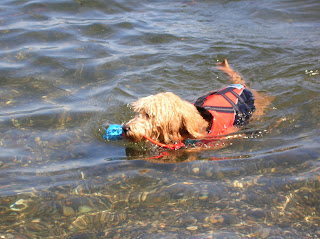
We took Rubin to the lake this morning. We walked through the woods and ended up at the edge of the water where he was more than ready to dive right in. Since he's just a pup and the waves can be a bit overwhelming, we purchased a floatation device for him yesterday (the flyer with the vest insisted this was not a life vest, but rather a floatation device!). He was skeptical of it yesterday when we went o visit our friends Doris and Stephen who have a small pool built into their backyard. He sort of flopped around in it, worried by the straps that dangled at his feet. Actually, Rubin was skeptical of the pool itself, but once he found the short step leading into the clear, blue water, he tumbled right in.
His bravery waivered though after he swam across the pool responding to Ann's call and shortly realized there was NOT a short step OUT of the pool. After a wee bit of panic, we swooped him out of the water and he raced around the edges of the pool while we took a swim to cool off.
This morning we strapped him into his floatation device, threw his favorite blue ball with the orange string into the water, and off he went fashionably dressed in lifesaving orange!
Not much to do today but find a cool place to rest and perhaps finish the young adult fiction book I've been reading. The cool places are far and in between though, so I may have to join Rubin on the floor.
Sunday, July 08, 2007
Eating Denmark Part Two: Driving with Corpses
“People will wonder why you’re driving around with three corpses in your car.”
My aunt was asleep in the passenger seat, or so I thought. Her head bobbed a bit, but I glanced over just in time to see her smile when she said “corpses.” I smiled, too. It was another example of her dry wit and it caught me a bit off guard.
We’d been driving from Glen Arbor back to Sutton’s Bay; about a 45 minute drive through the back roads of Michigan. We’d spent the day at the Sleeping Bear Sand Dunes and then picnicked at a nearby park. Ahead of me was my cousin, Mary, her call filled with the teenagers from our group. Behind me, an array of cousins and second cousins, a caravan of relatives. In my car, Aunt Edith, my cousin Sally, and my mother, no one except me, under the age of 70. They’d been talking as I drove, clarifying details of the past like sorting buttons in an old sewing kit. At one point Aunt Edith, about to comment on her daughter’s choice of car ahead of us said, “Well, I just wish she would…” and her voice trailed off. I caught my mother’s eye in the rearview mirror and we shared a knowing smile. Sure enough, when I glanced at my Aunt she was drooping, head slightly bouncing back, fast asleep. Within moments, the whole car was silent and when I looked in the mirror at my mother again, she and my cousin Sally looked like bobble head dolls, nodding to the rhythm of the road.
I focused on the road for the next 30 minutes, a bit drowsy, and willed myself not to turn on the radio for fear of waking my elders. It was the first quiet moment since we’d arrived in Michigan four days earlier and though I was tired, I relished the opportunity to listen to nothing.
My mother is a storyteller. She spins long, detailed memoirs at the dinner table remembering every name, every location, and almost every date. Even when my father tells a story, my mother fills in the names, corrects the dates, and raises a questioning eyebrow at the settings of his tales. The stories are never straight. They do not follow along like chapters in a book but rather unfold like origami and then fold back again from bird to flat paper and then back into a magnificently intricate winged bird.
I thought this ability to float a tale in the air was purely a skill of my mother’s, but after my first day with her extended family I was beginning to understand it as more of a genetic trait.
“Well, you know, Maryellen,” my aunt would begin, “That’s the time Norman stole checks from Dad and he was lucky to walk away alive from that mistake.”
“That wasn’t the first time Norman tested Dad’s patience,” my mother interjected and from there the two swapped story after story of Norman’s mischief and misdeeds and my Grandfather’s angry reprisals.
My mother and my Aunt are almost spitting images of each other even though seven years separate them. Their round faces and high cheekbones are haloed by a circle of gray curls (what I’ve jokingly called a poodle cut) and when my mother takes out her dentures, the resemblance is uncanny. It’s not only their looks that mirror each other, but their speech cadence, the set of their jaws when intently listening, and the lift of their eyebrows when a story strays from a detail they remember a different way. Even their laughs are identical and only when they sit side-by-side are their differences readily apparent.
For starters, my mother is a devoted Democrat, working for the political party most of her adult life. Aunt Edith, on the other hand, is a religious Republican, unafraid to share her opinions with anyone who will listen. My mother is an amazing cook, whipping up gourmet meals and desserts for political dinner parties and social gatherings. My aunt can cook, but her idea of gourmet is a layered salad slathered with sour cream, canned peas, and pearl onions. At one point during the visit, I was ordered (for my Aunt can phrase any plea for assistance more like a command than a request) to report to the kitchen no later than four in the afternoon for my tutoring in how to make (construct, really) an ice cream cake.
Ice cream cake is one of the few things I remember about my Grandmother. When we drove back in the summer from the Pacific Northwest to Des Moines, Iowa when I was a child I’d run into my Grandmother’s apartment and check her freezer never to be disappointed by the layered pastels of a sherbet frozen cake wrapped in thick whipped-cream frosting.
“It’s time I passed on the tradition,” Aunt Edith informed me and for the next hour we cut angel food cake with an electric knife, added drops of food dye to Cool Whip, and positioned slabs of rainbow sherbet so the cake lay level and round.
Later, she roped me into making a fruit salad claiming she couldn’t read the recipe she most likely read a million times before. After stirring the brown sugar and the walnuts and the marshmallows and the coconut and oh yes, the canned mandarin oranges and pineapple bits (which constituted the “fruit” in the fruit salad), we pulled the setting ice cream cake from the freezer just in time to thickly spread the Cool Whip icing around the edges, over the level top and stuff it down through the hole in the center.
Other differences between my mother and my aunt are in their level of patience. The double entendre of “it’s all relative” comes to mind. There are times, with my mother, that I feel we are always in a rush to get somewhere or complete a task or even just move through life. Patient is never a word I’d really use to describe my mother since she rarely sits down and when she does, is continuously busy with something – a book to read, a shirt to sew up, a letter to write. She works at a pace that exhausts me and though her words may sound supportive and patient, there’s an underlying edge that has always made me feel a bit doubtful of my actions.
But compared to my Aunt, my mother is the poster child of patience and acceptance.
“Well, I just want us to be aware of the time,” my Aunt would say again and again. “We don’t want to be late or keep the restaurant waiting!”
It was perhaps an hour before we needed to get going when she said this and her daughter, Mary who’d made the reservation and knew how to get where we intended to go was no where to be found. It was a like a push-me-pull-me cartoon – Aunt Edith wanted to get a move on while Mary was still putting all the pieces together – dressing her kids, walking the dog, finishing a conversation with another relative.
But we moved like a herd of cats throughout the week heightening my Aunt’s need to be early and rushing my already scattered cousin.
I had vowed weeks before my arrival that this trip was all about my mother. Truth be told, I didn’t really want to go to Michigan, but it meant a lot to my mother so I bought the ticket and packed my bags. Throughout the journey there I practiced my deep breathing and when our plane was delayed in Chicago making our connection with my sister in Traverse City hours late, I was a model of yogic patience.
Still, I stayed calm reading my book, intermittently solving a Sudoku puzzle or two, and when my eyes were tired, people watching.
I find Midwesterners to be a friendly bunch, but distinctly different than those of us from the Pacific Northwest. I was born in Iowa City, but when I was nine months old, my parents packed up the Plymouth Valiant station wagon and shipped us all – my brother, sister, and I – to Bremerton, Washington. For a few years after the move, we’d travel back in our Plymouth to spend our summers in Iowa while my father worked on his PhD. Though I was born in the land of corn, I have always considered myself a Washingtonian with Washingtonian affects and a penchant for cool, rainy weather.
My partner would disagree. Ann’s a born and bred Wisconsinite, a Madisonian to be specific and I still chuckle when she flattens out her vowels as she excitedly tells a story. My parents, Midwesterners too, love it as well. Ann says that you can always tell a Midwesterner because they can carry on a conversation anywhere, any time, and yes, about any subject though they prefer talking about the weather. When I ask for specifics about why she sees me as more of a mid-country person than a West Coaster, she’s short on examples usually ending the conversation with “I can just tell.”
While my mother and I sat stranded in the O’Hare Airport, I still didn’t see much resemblance between me and all the others seated around us. Then my mother struck up a conversation with the woman sitting next to her and before I knew it, I was involved in the conversation at first because I was embarrassed that my mother was sharing so many family stories and later because I wanted to add details to her tales.
“Oh my god,” I thought, “I AM a Midwesterner!”
By the time we got on the plane I was exhausted. I’m not a very comfortable passenger on planes and generally I don’t sleep for any length of time. But the second the small plane took off, I could feel my head toss back and melt warmly into the headrest. I woke up only once during the flight, to the weight of my jaw slack and heavy and then nodded back to sleep, an upright corpse on her way to Traverse City or as I jokingly came to refer to it – Traversity.
My aunt was asleep in the passenger seat, or so I thought. Her head bobbed a bit, but I glanced over just in time to see her smile when she said “corpses.” I smiled, too. It was another example of her dry wit and it caught me a bit off guard.
We’d been driving from Glen Arbor back to Sutton’s Bay; about a 45 minute drive through the back roads of Michigan. We’d spent the day at the Sleeping Bear Sand Dunes and then picnicked at a nearby park. Ahead of me was my cousin, Mary, her call filled with the teenagers from our group. Behind me, an array of cousins and second cousins, a caravan of relatives. In my car, Aunt Edith, my cousin Sally, and my mother, no one except me, under the age of 70. They’d been talking as I drove, clarifying details of the past like sorting buttons in an old sewing kit. At one point Aunt Edith, about to comment on her daughter’s choice of car ahead of us said, “Well, I just wish she would…” and her voice trailed off. I caught my mother’s eye in the rearview mirror and we shared a knowing smile. Sure enough, when I glanced at my Aunt she was drooping, head slightly bouncing back, fast asleep. Within moments, the whole car was silent and when I looked in the mirror at my mother again, she and my cousin Sally looked like bobble head dolls, nodding to the rhythm of the road.
I focused on the road for the next 30 minutes, a bit drowsy, and willed myself not to turn on the radio for fear of waking my elders. It was the first quiet moment since we’d arrived in Michigan four days earlier and though I was tired, I relished the opportunity to listen to nothing.
My mother is a storyteller. She spins long, detailed memoirs at the dinner table remembering every name, every location, and almost every date. Even when my father tells a story, my mother fills in the names, corrects the dates, and raises a questioning eyebrow at the settings of his tales. The stories are never straight. They do not follow along like chapters in a book but rather unfold like origami and then fold back again from bird to flat paper and then back into a magnificently intricate winged bird.
I thought this ability to float a tale in the air was purely a skill of my mother’s, but after my first day with her extended family I was beginning to understand it as more of a genetic trait.
“Well, you know, Maryellen,” my aunt would begin, “That’s the time Norman stole checks from Dad and he was lucky to walk away alive from that mistake.”
“That wasn’t the first time Norman tested Dad’s patience,” my mother interjected and from there the two swapped story after story of Norman’s mischief and misdeeds and my Grandfather’s angry reprisals.
My mother and my Aunt are almost spitting images of each other even though seven years separate them. Their round faces and high cheekbones are haloed by a circle of gray curls (what I’ve jokingly called a poodle cut) and when my mother takes out her dentures, the resemblance is uncanny. It’s not only their looks that mirror each other, but their speech cadence, the set of their jaws when intently listening, and the lift of their eyebrows when a story strays from a detail they remember a different way. Even their laughs are identical and only when they sit side-by-side are their differences readily apparent.
For starters, my mother is a devoted Democrat, working for the political party most of her adult life. Aunt Edith, on the other hand, is a religious Republican, unafraid to share her opinions with anyone who will listen. My mother is an amazing cook, whipping up gourmet meals and desserts for political dinner parties and social gatherings. My aunt can cook, but her idea of gourmet is a layered salad slathered with sour cream, canned peas, and pearl onions. At one point during the visit, I was ordered (for my Aunt can phrase any plea for assistance more like a command than a request) to report to the kitchen no later than four in the afternoon for my tutoring in how to make (construct, really) an ice cream cake.
Ice cream cake is one of the few things I remember about my Grandmother. When we drove back in the summer from the Pacific Northwest to Des Moines, Iowa when I was a child I’d run into my Grandmother’s apartment and check her freezer never to be disappointed by the layered pastels of a sherbet frozen cake wrapped in thick whipped-cream frosting.
“It’s time I passed on the tradition,” Aunt Edith informed me and for the next hour we cut angel food cake with an electric knife, added drops of food dye to Cool Whip, and positioned slabs of rainbow sherbet so the cake lay level and round.
Later, she roped me into making a fruit salad claiming she couldn’t read the recipe she most likely read a million times before. After stirring the brown sugar and the walnuts and the marshmallows and the coconut and oh yes, the canned mandarin oranges and pineapple bits (which constituted the “fruit” in the fruit salad), we pulled the setting ice cream cake from the freezer just in time to thickly spread the Cool Whip icing around the edges, over the level top and stuff it down through the hole in the center.
Other differences between my mother and my aunt are in their level of patience. The double entendre of “it’s all relative” comes to mind. There are times, with my mother, that I feel we are always in a rush to get somewhere or complete a task or even just move through life. Patient is never a word I’d really use to describe my mother since she rarely sits down and when she does, is continuously busy with something – a book to read, a shirt to sew up, a letter to write. She works at a pace that exhausts me and though her words may sound supportive and patient, there’s an underlying edge that has always made me feel a bit doubtful of my actions.
But compared to my Aunt, my mother is the poster child of patience and acceptance.
“Well, I just want us to be aware of the time,” my Aunt would say again and again. “We don’t want to be late or keep the restaurant waiting!”
It was perhaps an hour before we needed to get going when she said this and her daughter, Mary who’d made the reservation and knew how to get where we intended to go was no where to be found. It was a like a push-me-pull-me cartoon – Aunt Edith wanted to get a move on while Mary was still putting all the pieces together – dressing her kids, walking the dog, finishing a conversation with another relative.
But we moved like a herd of cats throughout the week heightening my Aunt’s need to be early and rushing my already scattered cousin.
I had vowed weeks before my arrival that this trip was all about my mother. Truth be told, I didn’t really want to go to Michigan, but it meant a lot to my mother so I bought the ticket and packed my bags. Throughout the journey there I practiced my deep breathing and when our plane was delayed in Chicago making our connection with my sister in Traverse City hours late, I was a model of yogic patience.
Still, I stayed calm reading my book, intermittently solving a Sudoku puzzle or two, and when my eyes were tired, people watching.
I find Midwesterners to be a friendly bunch, but distinctly different than those of us from the Pacific Northwest. I was born in Iowa City, but when I was nine months old, my parents packed up the Plymouth Valiant station wagon and shipped us all – my brother, sister, and I – to Bremerton, Washington. For a few years after the move, we’d travel back in our Plymouth to spend our summers in Iowa while my father worked on his PhD. Though I was born in the land of corn, I have always considered myself a Washingtonian with Washingtonian affects and a penchant for cool, rainy weather.
My partner would disagree. Ann’s a born and bred Wisconsinite, a Madisonian to be specific and I still chuckle when she flattens out her vowels as she excitedly tells a story. My parents, Midwesterners too, love it as well. Ann says that you can always tell a Midwesterner because they can carry on a conversation anywhere, any time, and yes, about any subject though they prefer talking about the weather. When I ask for specifics about why she sees me as more of a mid-country person than a West Coaster, she’s short on examples usually ending the conversation with “I can just tell.”
While my mother and I sat stranded in the O’Hare Airport, I still didn’t see much resemblance between me and all the others seated around us. Then my mother struck up a conversation with the woman sitting next to her and before I knew it, I was involved in the conversation at first because I was embarrassed that my mother was sharing so many family stories and later because I wanted to add details to her tales.
“Oh my god,” I thought, “I AM a Midwesterner!”
By the time we got on the plane I was exhausted. I’m not a very comfortable passenger on planes and generally I don’t sleep for any length of time. But the second the small plane took off, I could feel my head toss back and melt warmly into the headrest. I woke up only once during the flight, to the weight of my jaw slack and heavy and then nodded back to sleep, an upright corpse on her way to Traverse City or as I jokingly came to refer to it – Traversity.
Saturday, July 07, 2007
Eating Denmark: Part One
On a recent family-reunion vacation, my mother described her dream to me.
It was her mother's birthday and my mother had designed a beautiful chocolate cake in the shape of Denmark, the birthplace of my grandmother. The cake was laid out on a flat-mirrored platter and was detailed down to the last little isalnd floating on the reflective surface. The birthday celebration was to be head at one end of a large gymnasium surrounded by tiered levels of an arena. Before the event could get stared, two full basketball teams, complete with cheerleading squads swarmed down the aisles and onto the court bouncing their balls, running their warm-ups, and shaking their pom-poms. Mother, as she recounts the dream, said she was furious. She could feel her anger hot in her face, her hands clenched tightly along the edges of the mirrored cake platter. But everyone at the party -- relatives, long-time friends and aquaintances -- told her not to worry that everything would be all right. So they packed up the celebration and moved to a room upstairs away from the sweaty basketball teams and their adoring cheerleaders. Meanwhile, the cake slowly melted and my mother had to lick the drippings off the sides with her fingers.
“What does it mean?” I asked her when she’d finished recounting the dream.
“Oh, honey, I don’t know,” she sighed. “I’d have to look up all the symbolism in my dream books to really get down to all the layers.”
We were sitting at my aunt’s dining room table just outside of Sutton’s Bay, Michigan. My aunt, my mother’s older sister, was 87 at the time and the point of our visit was a female family reunion. The Jensen clan, my mother’s family, consisted of three daughters and three sons, but of the 17 grandchildren, 11 of them were girls all of whom agreed to gather mid-June in Michigan at the request of Edith, now the oldest matriarch of the family.
Growing up I was aware of my extended family, but not particularly close to any of them. My father’s side of the family is minimal compared with my mother’s and except for a few summer visits from cousins and our belligerent and hateful paternal grandfather, my father’s family was a mystery to me. My mother, on the other hand, always kept in contact with her sprawling cousins and their children, sitting down every Christmas to send detailed letters folded into holiday cards and mailing stacks of them off to all four corners of the globe.
Still, despite her diligence at maintaining the family tree, the names on the envelopes did not register faces in my memory.
If the Jensen clan is known for anything, they are known for their longevity. My mother, now 80 often outlasts me, her pace only slower recently because of a bum hip and swollen knees. Aunt Edith walks with a cane and bends slightly to the left with a bad back and recovery from a broken hip, but she can still challenge the likes of the Energizer bunny even under the influence of Vicadin.
Ten years ago an even larger extended clan met in Sutherland, Iowa birthplace of the Jensen children for the celebration of my Aunt Anna’s 90th birthday. In the basement of VFW halls and churches, long tables held the food I fondly remembered from my childhood – egg-yellow potato salad, Jello concoctions filled with fruit and marshmallows, and my personal favorite, cold slaw with just the right blend of tangy dressing. Stretched out on another table were huge displays of the various branches of the family tree. My grandfather, Christian, had three brothers and one sister each of whom appeared to be as prolific as my grandfather. During that reunion, I met more people who looked vaguely familiar if only because we shared the same high cheekbones or unusually broad shoulders. Inundated with names of relatives I didn’t quite know, I asked my mother to explain relationships by referring to one of the many family trees. It was during that vacation that I finally grasped the concept of second cousins twice removed though now I’m not certain I could explain it to anyone else.
Aunt Anna died at age 96, crippled with arthritis, almost completely blind, and uncertain of her surroundings at any given moment. My mother, 18 years younger, looked to Anna as more of a mother than a sister especially after their mother died when my mother was in her early 40’s. I, too, looked to Anna as more of a grandmother than an Aunt and therefore viewed my cousins as more of aunts than contemporaries.
I was 10 when my grandmother died, but I did not travel back from the state of Washington to Sutherland, Iowa to attend her funeral. In fact, I have very few memories of my grandmother though I do remember her straight, straight back, her powdery smell of lavender, her ice cream cakes, and the one time she let me undo her gray hair from its tight bun so I could comb it in the downstairs bathroom of our 17th Street house.
Traveling to Michigan to Aunt Edith’s brought many of the scattered pieces of my family tree together for me this time. No longer were relations just names branched out on butcher paper, but they were faces, some of whom I knew, some of whom I did not and stories, like stones in a river, each with their own unique patterns and weight, curves and textures.
We were called together, I learned in the middle of the trip, to hear the stories of both my Aunt and my mother. On one night, they were to tell the tale of my grandfather and grandmother’s life in Denmark, their meeting and marriage in Iowa, and the birth of their six children. While that night did occur, the stories flowed throughout the week and by the end, were repeated more than once to those of us who stayed the longest.
By the end of the week, I was exhausted by late nights and overlapping stories, by my energetic and demanding sister, and my equally forceful and demanding aunt. Many of the conversations that week were exercises in minutiae – details of minute-by-minute accounts describing the purchasing of a particular cereal or the recounting of a recent doctor’s visit. At first, all conversations were polite, the audience attentive, listeners locked in eye contact with the storyteller. By the end of the week, relatives stood up and ventured into the kitchen to choose from the abundance of snacks mid-story leaving the storyteller hanging on details they felt to be of the greatest import.
In other words, the beautiful cake of Denmark dripped at times, melting over the edges of even the best-laid plans. There was not much else to do, but lick the fingers of our mess and turn to each other and say, “Don’t worry, it will be all right.”
It was her mother's birthday and my mother had designed a beautiful chocolate cake in the shape of Denmark, the birthplace of my grandmother. The cake was laid out on a flat-mirrored platter and was detailed down to the last little isalnd floating on the reflective surface. The birthday celebration was to be head at one end of a large gymnasium surrounded by tiered levels of an arena. Before the event could get stared, two full basketball teams, complete with cheerleading squads swarmed down the aisles and onto the court bouncing their balls, running their warm-ups, and shaking their pom-poms. Mother, as she recounts the dream, said she was furious. She could feel her anger hot in her face, her hands clenched tightly along the edges of the mirrored cake platter. But everyone at the party -- relatives, long-time friends and aquaintances -- told her not to worry that everything would be all right. So they packed up the celebration and moved to a room upstairs away from the sweaty basketball teams and their adoring cheerleaders. Meanwhile, the cake slowly melted and my mother had to lick the drippings off the sides with her fingers.
“What does it mean?” I asked her when she’d finished recounting the dream.
“Oh, honey, I don’t know,” she sighed. “I’d have to look up all the symbolism in my dream books to really get down to all the layers.”
We were sitting at my aunt’s dining room table just outside of Sutton’s Bay, Michigan. My aunt, my mother’s older sister, was 87 at the time and the point of our visit was a female family reunion. The Jensen clan, my mother’s family, consisted of three daughters and three sons, but of the 17 grandchildren, 11 of them were girls all of whom agreed to gather mid-June in Michigan at the request of Edith, now the oldest matriarch of the family.
Growing up I was aware of my extended family, but not particularly close to any of them. My father’s side of the family is minimal compared with my mother’s and except for a few summer visits from cousins and our belligerent and hateful paternal grandfather, my father’s family was a mystery to me. My mother, on the other hand, always kept in contact with her sprawling cousins and their children, sitting down every Christmas to send detailed letters folded into holiday cards and mailing stacks of them off to all four corners of the globe.
Still, despite her diligence at maintaining the family tree, the names on the envelopes did not register faces in my memory.
If the Jensen clan is known for anything, they are known for their longevity. My mother, now 80 often outlasts me, her pace only slower recently because of a bum hip and swollen knees. Aunt Edith walks with a cane and bends slightly to the left with a bad back and recovery from a broken hip, but she can still challenge the likes of the Energizer bunny even under the influence of Vicadin.
Ten years ago an even larger extended clan met in Sutherland, Iowa birthplace of the Jensen children for the celebration of my Aunt Anna’s 90th birthday. In the basement of VFW halls and churches, long tables held the food I fondly remembered from my childhood – egg-yellow potato salad, Jello concoctions filled with fruit and marshmallows, and my personal favorite, cold slaw with just the right blend of tangy dressing. Stretched out on another table were huge displays of the various branches of the family tree. My grandfather, Christian, had three brothers and one sister each of whom appeared to be as prolific as my grandfather. During that reunion, I met more people who looked vaguely familiar if only because we shared the same high cheekbones or unusually broad shoulders. Inundated with names of relatives I didn’t quite know, I asked my mother to explain relationships by referring to one of the many family trees. It was during that vacation that I finally grasped the concept of second cousins twice removed though now I’m not certain I could explain it to anyone else.
Aunt Anna died at age 96, crippled with arthritis, almost completely blind, and uncertain of her surroundings at any given moment. My mother, 18 years younger, looked to Anna as more of a mother than a sister especially after their mother died when my mother was in her early 40’s. I, too, looked to Anna as more of a grandmother than an Aunt and therefore viewed my cousins as more of aunts than contemporaries.
I was 10 when my grandmother died, but I did not travel back from the state of Washington to Sutherland, Iowa to attend her funeral. In fact, I have very few memories of my grandmother though I do remember her straight, straight back, her powdery smell of lavender, her ice cream cakes, and the one time she let me undo her gray hair from its tight bun so I could comb it in the downstairs bathroom of our 17th Street house.
Traveling to Michigan to Aunt Edith’s brought many of the scattered pieces of my family tree together for me this time. No longer were relations just names branched out on butcher paper, but they were faces, some of whom I knew, some of whom I did not and stories, like stones in a river, each with their own unique patterns and weight, curves and textures.
We were called together, I learned in the middle of the trip, to hear the stories of both my Aunt and my mother. On one night, they were to tell the tale of my grandfather and grandmother’s life in Denmark, their meeting and marriage in Iowa, and the birth of their six children. While that night did occur, the stories flowed throughout the week and by the end, were repeated more than once to those of us who stayed the longest.
By the end of the week, I was exhausted by late nights and overlapping stories, by my energetic and demanding sister, and my equally forceful and demanding aunt. Many of the conversations that week were exercises in minutiae – details of minute-by-minute accounts describing the purchasing of a particular cereal or the recounting of a recent doctor’s visit. At first, all conversations were polite, the audience attentive, listeners locked in eye contact with the storyteller. By the end of the week, relatives stood up and ventured into the kitchen to choose from the abundance of snacks mid-story leaving the storyteller hanging on details they felt to be of the greatest import.
In other words, the beautiful cake of Denmark dripped at times, melting over the edges of even the best-laid plans. There was not much else to do, but lick the fingers of our mess and turn to each other and say, “Don’t worry, it will be all right.”
Monday, July 02, 2007
Memory Fishing
Ann attended a writing class (on how to teach writing) and had to actually write an essay. I helped a smidge, but asked her if I could post her piece on my blog. She agreed so here it is:

Forty years later my older brother, Phil, cut the engine of my dad’s car as we arrived at my Dad’s house. The surrounding cornfields hadn’t been plowed under yet to make way for the new spring plantings. The stalks lay broken and bent. I was thankful to step out of the stale smell of the car’s interior to the fresh country air. I stretched after my long hours sitting on a plane and took in the full view of the farm land around me.
“We’ve been cleaning the house the past week while Dad’s been in the hospital,” Phil stated matter-of-factly. “It was really disgusting. I think he hasn’t been cleaning the house for the past few months. You better prepare yourself.”
I hesitated, positioning myself so I was the last to enter. We walked up to the front door, but the screen door resisted and stuck so Phil had to use both hands to pry it open. It remained open and that’s when the decades old cigarette smell burned my nostrils. I thought, “God, I’m so glad I didn’t arrange to stay here at the house.” As usual, seeing my dad was always a secondary experience to the assault on my senses. I blinked rapidly as my eyes watered from the intense concentration of stale smoke.
Then I saw my dad sitting in his new recliner that we, his three kids, had bought him the previous Christmas. The recliner was massive; a blue raft. He looked as if he were floating down a river minus a beer in one hand and a cigarette in the other. Instead, I saw the whitecaps of used tissues surrounding him, and ahead, instead of the bend in the river there was a brand new wide-screen HDTV tuned to a golf tournament.
He looked so small.
When he saw me, my father raised his head to give a nod and a grunt, and then he rubbed his head as if he were sick. My father was never sick. Until now. I moved to give him a hug and a kiss and felt him having trouble keeping up with my swift greeting, his lips still puckered after I had withdrawn to sit down. He quickly spat into a tissue and soon I saw that he did this with the same timing as when he puffed on a cigarette. The white plastic garbage bag was full and had become his new ashtray.
“How are you?” I asked.
“Not so good,” he grunted and shook his head and again rubbed it.
Phil began talking and soon his voice filled in both sides of the conversation. I got thirsty and excused myself to go to the kitchen. Phil came up behind me and explained how he and his wife had removed all the food and drinks from the fridge and cleaned out the cupboards now that Dad couldn’t eat or drink. He pointed to case after case of Dad’s liquid food for his G-tube, a tube inserted into the stomach into which Dad poured the cans a few times a day. The stacked cases reminded me of the dog food from my own home.
Esophageal cancer was the diagnosis; a six centimeter cancerous tumor had blocked his esophagus and was migrating rapidly throughout his body. Phil explained how the doctors were talking about chemotherapy so dad could at least swallow, but the outlook was grim.
At the sink all the old ashtrays I’d grown up with were stacked and clean for the first time ever. I also noticed the old instant coffee pot on the bare counter unplugged and stained from old spills. My dad loved his coffee and we used to laugh at the sound of the spoon rhythmically hitting the sides of the mug long after the sugar had dissolved.
Suddenly, I thought, “If he can’t eat or drink, how can he breathe?” I practiced with my own mouth and nose, breathing-swallowing-inhaling-exhaling-swallowing, it became confusing since it was all so automatic for me.
I immediately thought He could actually smoke if he wanted to. I asked him and he said he had no desire to smoke since his throat was so dry. I looked at his pale, drawn face and gave him an ironic smile. Finally, my wish had come true. My dad had quit smoking.
When I returned home to Seattle a few days later, I received the dreaded phone call in the middle of the night. The next morning I was back on a plane, driving through the cornfields and turning into the driveway, once again at my father’s house. My brother and sister-in-law had done most of the cleaning, attempting to elbow grease the yellow stains from the walls and fabric of a 70 year old man’s bad habits. Still, there was sorting to do, combing through and divvying up our father’s belongings.
There wasn’t much I wanted, but in the basement, hanging in the rafters I spotted my special fishing pole. The memories of the aluminum boat washed over me; my dad’s grin, his hand on the steering wheel, and the flopping Northern Pike in the belly of the boat. I easily could have taken the pole. It was mine and my father had kept it all these years perhaps with the knowledge that I’d return for it after his passing. But in the end, I left it for my brother’s grandkids knowing one day, he’d take them on a quiet lake somewhere and gently rock his way into their memory as my father had done with me.
Every summer our family of five went on vacation camping in Northern Wisconsin. The trips always involved fishing with my dad. Just the two of us in a simple aluminum motorboat; me, sitting high at the bow with my puffy life vest on and Dad grinning at the back while steering the small outboard motor holding a cigarette in one hand and with his other hand. holding onto the side of the boat as he tried to bounce me over the waves.
We’d fish for hours without a word exchanged between us, the silence only broken with by childish scream every time I’d catch the abundant perch or on special occasions, a good size Northern Pike. At those times, I’d look over to my dad to confirm the fish’s identity and he’d let me know if it was big enough to keep. His eyebrows raised and I’d see his face light up. “That’s a pretty good one,” he’d grunt and we’d go back to our silence. I loved sharing these times with my dad, but I hated each cigarette’s red hot end and the smoke that always hung in the air between us as we fished on quiet, calm lakes.
We’d fish for hours without a word exchanged between us, the silence only broken with by childish scream every time I’d catch the abundant perch or on special occasions, a good size Northern Pike. At those times, I’d look over to my dad to confirm the fish’s identity and he’d let me know if it was big enough to keep. His eyebrows raised and I’d see his face light up. “That’s a pretty good one,” he’d grunt and we’d go back to our silence. I loved sharing these times with my dad, but I hated each cigarette’s red hot end and the smoke that always hung in the air between us as we fished on quiet, calm lakes.
Forty years later my older brother, Phil, cut the engine of my dad’s car as we arrived at my Dad’s house. The surrounding cornfields hadn’t been plowed under yet to make way for the new spring plantings. The stalks lay broken and bent. I was thankful to step out of the stale smell of the car’s interior to the fresh country air. I stretched after my long hours sitting on a plane and took in the full view of the farm land around me.
“We’ve been cleaning the house the past week while Dad’s been in the hospital,” Phil stated matter-of-factly. “It was really disgusting. I think he hasn’t been cleaning the house for the past few months. You better prepare yourself.”
I hesitated, positioning myself so I was the last to enter. We walked up to the front door, but the screen door resisted and stuck so Phil had to use both hands to pry it open. It remained open and that’s when the decades old cigarette smell burned my nostrils. I thought, “God, I’m so glad I didn’t arrange to stay here at the house.” As usual, seeing my dad was always a secondary experience to the assault on my senses. I blinked rapidly as my eyes watered from the intense concentration of stale smoke.
Then I saw my dad sitting in his new recliner that we, his three kids, had bought him the previous Christmas. The recliner was massive; a blue raft. He looked as if he were floating down a river minus a beer in one hand and a cigarette in the other. Instead, I saw the whitecaps of used tissues surrounding him, and ahead, instead of the bend in the river there was a brand new wide-screen HDTV tuned to a golf tournament.
He looked so small.
When he saw me, my father raised his head to give a nod and a grunt, and then he rubbed his head as if he were sick. My father was never sick. Until now. I moved to give him a hug and a kiss and felt him having trouble keeping up with my swift greeting, his lips still puckered after I had withdrawn to sit down. He quickly spat into a tissue and soon I saw that he did this with the same timing as when he puffed on a cigarette. The white plastic garbage bag was full and had become his new ashtray.
“How are you?” I asked.
“Not so good,” he grunted and shook his head and again rubbed it.
Phil began talking and soon his voice filled in both sides of the conversation. I got thirsty and excused myself to go to the kitchen. Phil came up behind me and explained how he and his wife had removed all the food and drinks from the fridge and cleaned out the cupboards now that Dad couldn’t eat or drink. He pointed to case after case of Dad’s liquid food for his G-tube, a tube inserted into the stomach into which Dad poured the cans a few times a day. The stacked cases reminded me of the dog food from my own home.
Esophageal cancer was the diagnosis; a six centimeter cancerous tumor had blocked his esophagus and was migrating rapidly throughout his body. Phil explained how the doctors were talking about chemotherapy so dad could at least swallow, but the outlook was grim.
At the sink all the old ashtrays I’d grown up with were stacked and clean for the first time ever. I also noticed the old instant coffee pot on the bare counter unplugged and stained from old spills. My dad loved his coffee and we used to laugh at the sound of the spoon rhythmically hitting the sides of the mug long after the sugar had dissolved.
Suddenly, I thought, “If he can’t eat or drink, how can he breathe?” I practiced with my own mouth and nose, breathing-swallowing-inhaling-exhaling-swallowing, it became confusing since it was all so automatic for me.
I immediately thought He could actually smoke if he wanted to. I asked him and he said he had no desire to smoke since his throat was so dry. I looked at his pale, drawn face and gave him an ironic smile. Finally, my wish had come true. My dad had quit smoking.
When I returned home to Seattle a few days later, I received the dreaded phone call in the middle of the night. The next morning I was back on a plane, driving through the cornfields and turning into the driveway, once again at my father’s house. My brother and sister-in-law had done most of the cleaning, attempting to elbow grease the yellow stains from the walls and fabric of a 70 year old man’s bad habits. Still, there was sorting to do, combing through and divvying up our father’s belongings.
There wasn’t much I wanted, but in the basement, hanging in the rafters I spotted my special fishing pole. The memories of the aluminum boat washed over me; my dad’s grin, his hand on the steering wheel, and the flopping Northern Pike in the belly of the boat. I easily could have taken the pole. It was mine and my father had kept it all these years perhaps with the knowledge that I’d return for it after his passing. But in the end, I left it for my brother’s grandkids knowing one day, he’d take them on a quiet lake somewhere and gently rock his way into their memory as my father had done with me.
Thursday, June 28, 2007
No Go Chicago!

Waiting is not my virtue. I'd rather drive the long way around than sit at a stoplight in commuter traffic. I want to move forward. Just sitting is torturous.
So it was in this picture as we inched our way down the O'Hare Airport tarmac waiting and waiting and waiting to take off.
But back up a bit: First, we'd missed our connection to Seattle the day before. Half the world missed their connections, or so it seemed since the Chicago airport was busier than a wasp's nest during breeding season. Lines were the norm. Lines for the bathroom. Lines for the "red phones" where we were instructed to "rebook" our flight. Lines at the agent booths. Lines at the hotel kiosk. Lines for the taxi. Lines, lines, lines, and even more lines.
Then a night in a downtown Chicago hotel that cost my mother almost as much as my plane ticket to Michigan. And a visit to the gift shop for a toothbrush, a t-shirt, some snacks, and a pair of new underwear. Then breakfast the next morning, where a simple 2 eggs over easy, a side of toast, fresh fruit, and bacon tallied up to $18...for one person. Then another outrageously priced taxi ride back to the airport where it was eerily quiet and the lines were not nearly as long or as abundant.
But don't let that fool ya...the line was waiting for us on the tarmac. 30 planes waiting, waiting, waiting to fly out and the line of storm clouds circled around us like a noose. And the lines they repeated over and over: "We're sorry for the delay..." "We're doing everything we can to ensure a safe flight..." "We so appreciate your patience..." "Well, we tried to get you out of here on time, but it looks like we'll be here for another 30 minutes..."
But it was 2 1/2 hours out on that overheated runway. Thus, the grimmace of impatience.
We missed our connection in Salt Lake, but our luck turned as Delta airlines rebooked us automatically onto the next flight out.
26 hours overdue we landed in Seattle, our luggage having arrived a day before us.
I'm home now and have more stories to tell. I learned a lot about myself on this trip even though I wasn't planning on such introspection. But those will have to wait until I unpack, do the laundry, play with the growing puppy, eat some "real" food, and rest my weary waiting bones.
Tuesday, June 19, 2007
What's A Girl To Do?
The first dilemma I face with my family reunion trip to Michigan is figuring out what to pack. I have always struggled with packing. I either over pack or under pack and when I arrive at my destination -- be it another state, another country, a campground, or a hotel -- I am without the clothes that make me feel safe, make me feel comfortable, make me feel like myself.
Tomorrow I fly, with my 80 year old mother, to see her older sister in Sutton's Bay, Michigan. Along the way we will meet up with my older sister, my only sister and make our way to Traverse City, just south of Sutton's Bay. It's not traveling with my mother that worries me or meeting and socializing with relatives I've never met. It's not even spending four nights with my difficult sister in a hotel room or the overeating on the food that will be abundant and fattening and white (it is the midwest).
I worry instead about my selection of clothes -- will I be too hot in long pants or too cool in shorts? Does my shirt match the occasion? Do I look too muscular in a tank top? Will that redneck notice my "boyish" clothing? Will my pants fit after days of eating potato salad and white bread? Will I sweat too much in my linen shirt?
Ann, born and bred in the midwest, claims that no one there has any fashion sense. Dressing up, she says, means a clean pair of jeans and a polo shirt without a stain on the front. A few summer's ago, when we drove to Michigan to visit a friend, Ann screamed with delight when, somewhere in Minnesota I think, she saw a man at a rest stop dressed in a bright orange t-shirt, dramatically patterned baggy shorts, sandals and black socks pulled up to his knees. "We're in the midwest now, honey," she informed me and then, for the rest of our journey, men in similar dress kept popping up.
Now, when I share with her my fears of my fashion dilemma, she laughs and says, "Just pack some orange shirts and black socks. You'll be just fine."
Still, our bed is covered with all the clothes I wish to bring. There's no way they'd fit into the luggage, so I must winnow out the choice items from the must haves. Ann says she'll help me after work, but I'm not sure I trust her fashion sensibility. She left this morning dressed in beige shorts and a red shirt and when I saw the dark ankle socks, I made her change into her Keen sandals, sans socks.
The dilemma feels very complex because the items on the bed are the clothes I love the most because they are comfortable, uncomplicated, and the things I like to wear when I am on summer vacation (which officially started today). I want to take everything I've laid out, but I know it won't fit in the bag so I must decide which items will meet the following criteria: comfortable, weather flexible, and family appropriate.
Right now I'm wearing my "Got Privilege?" t-shirt, which I've thought about taking as a statement of my liberal politics, but the shirt is black and I know dark colors attract mosquitoes. Of course, almost all the clothes I have are dark in color. I live in the northwest -- few people wear white in June and I look ill in peach and yellow -- so my wardrobe consists of maroons and darker blues.
I do not own an orange t-shirt.
The complexity of this dilemma is that, once I cull out the bulkier items, will the clothes that remain make me feel good or will I feel deeply uncomfortable because every woman will be in a dress and I'll be in shorts? Or will I be squirming in pants that feel too tight or a shirt that clings to my back in the Michigan humidity? Will I wish I'd brought that shirt instead of this shirt or that bra instead of this one?
And I'm not even talking about shoes, yet! How many pairs of shoes can I fit in my bag and still have room for my clothes? And still know I've got the appropriate shoes for the appropriate situation? Not only do I not own any white pants (along with no orange shirts), I don't own white shoes or high heels.
I am pratical in every way. My clothes reflect that, but this trip isn't about practical. It's about visiting my aunt in her flowery polyester. It's about seeing my cousins in their white shorts and striped knit tops. It's about sharing a meal with distant relatives who wear diamond earrings and expensive shoes.
What's a girl to do?
I was sharing my dilemma with a woman from work. She's very young and she wears the oddest assortment of Thirft Store clothing (she came to work one day in a Wonder Woman costume complete with shiny gold breast plates). She dates a transgender man (currently in transition of female to male) who looks gorgeous in tight black jeans and a tight black t-shirt. She said I shouldn't worry. If I really wanted to know uncomfortable I should travel with her (dressed as she is with "boyfriend" in tow) and see the looks she gets when visiting family in Israel or Florida.
"Try something different," her boyfriend advised.
"Like what?" I query.
"I don't know. Wear a uni-tard and go-go boots. That will truly feel uncomfortable. Then wear your real clothes and you'll feel comfortable again."
Not a bad idea. I've often thought I should just fall into the stereotype so many have of "lesbians" and wear men's clothes in a very manly fashion. No need to worry about shoes, then.
"Wear an orange t-shirt," my co-worked advised. "When in Rome..." she reminded me.
But an orange t-shirt means I must go shopping and frankly, if I'm going to go shopping I refuse to waste my money on dark socks and orange shirts.
Maybe I should just buy another suitcase.
What IS a girl to do?
Tomorrow I fly, with my 80 year old mother, to see her older sister in Sutton's Bay, Michigan. Along the way we will meet up with my older sister, my only sister and make our way to Traverse City, just south of Sutton's Bay. It's not traveling with my mother that worries me or meeting and socializing with relatives I've never met. It's not even spending four nights with my difficult sister in a hotel room or the overeating on the food that will be abundant and fattening and white (it is the midwest).
I worry instead about my selection of clothes -- will I be too hot in long pants or too cool in shorts? Does my shirt match the occasion? Do I look too muscular in a tank top? Will that redneck notice my "boyish" clothing? Will my pants fit after days of eating potato salad and white bread? Will I sweat too much in my linen shirt?
Ann, born and bred in the midwest, claims that no one there has any fashion sense. Dressing up, she says, means a clean pair of jeans and a polo shirt without a stain on the front. A few summer's ago, when we drove to Michigan to visit a friend, Ann screamed with delight when, somewhere in Minnesota I think, she saw a man at a rest stop dressed in a bright orange t-shirt, dramatically patterned baggy shorts, sandals and black socks pulled up to his knees. "We're in the midwest now, honey," she informed me and then, for the rest of our journey, men in similar dress kept popping up.
Now, when I share with her my fears of my fashion dilemma, she laughs and says, "Just pack some orange shirts and black socks. You'll be just fine."
Still, our bed is covered with all the clothes I wish to bring. There's no way they'd fit into the luggage, so I must winnow out the choice items from the must haves. Ann says she'll help me after work, but I'm not sure I trust her fashion sensibility. She left this morning dressed in beige shorts and a red shirt and when I saw the dark ankle socks, I made her change into her Keen sandals, sans socks.
The dilemma feels very complex because the items on the bed are the clothes I love the most because they are comfortable, uncomplicated, and the things I like to wear when I am on summer vacation (which officially started today). I want to take everything I've laid out, but I know it won't fit in the bag so I must decide which items will meet the following criteria: comfortable, weather flexible, and family appropriate.
Right now I'm wearing my "Got Privilege?" t-shirt, which I've thought about taking as a statement of my liberal politics, but the shirt is black and I know dark colors attract mosquitoes. Of course, almost all the clothes I have are dark in color. I live in the northwest -- few people wear white in June and I look ill in peach and yellow -- so my wardrobe consists of maroons and darker blues.
I do not own an orange t-shirt.
The complexity of this dilemma is that, once I cull out the bulkier items, will the clothes that remain make me feel good or will I feel deeply uncomfortable because every woman will be in a dress and I'll be in shorts? Or will I be squirming in pants that feel too tight or a shirt that clings to my back in the Michigan humidity? Will I wish I'd brought that shirt instead of this shirt or that bra instead of this one?
And I'm not even talking about shoes, yet! How many pairs of shoes can I fit in my bag and still have room for my clothes? And still know I've got the appropriate shoes for the appropriate situation? Not only do I not own any white pants (along with no orange shirts), I don't own white shoes or high heels.
I am pratical in every way. My clothes reflect that, but this trip isn't about practical. It's about visiting my aunt in her flowery polyester. It's about seeing my cousins in their white shorts and striped knit tops. It's about sharing a meal with distant relatives who wear diamond earrings and expensive shoes.
What's a girl to do?
I was sharing my dilemma with a woman from work. She's very young and she wears the oddest assortment of Thirft Store clothing (she came to work one day in a Wonder Woman costume complete with shiny gold breast plates). She dates a transgender man (currently in transition of female to male) who looks gorgeous in tight black jeans and a tight black t-shirt. She said I shouldn't worry. If I really wanted to know uncomfortable I should travel with her (dressed as she is with "boyfriend" in tow) and see the looks she gets when visiting family in Israel or Florida.
"Try something different," her boyfriend advised.
"Like what?" I query.
"I don't know. Wear a uni-tard and go-go boots. That will truly feel uncomfortable. Then wear your real clothes and you'll feel comfortable again."
Not a bad idea. I've often thought I should just fall into the stereotype so many have of "lesbians" and wear men's clothes in a very manly fashion. No need to worry about shoes, then.
"Wear an orange t-shirt," my co-worked advised. "When in Rome..." she reminded me.
But an orange t-shirt means I must go shopping and frankly, if I'm going to go shopping I refuse to waste my money on dark socks and orange shirts.
Maybe I should just buy another suitcase.
What IS a girl to do?
Friday, June 15, 2007
The Seven Year Itch
I remember, a long time ago, someone telling me that when you are in a relationship, it's common to get what's called a seven year itch -- the desire for a change or the feeling that somewhere else lies greener grass. My partnership with Ann is by no means in jeopardy, but my relationship with my role as a teacher is once again creating a burning sensation under my skin.
Perhaps it's the loss of my teaching partner who, in her early thirties, has decided that she needs to stretch her occupational wings and give something other than teaching a try. Perhaps it's the end of the year exhaustion that I'm currently feeling on this last day of school. Perhaps it's the sun, which has decided to break through the recent rain, that calls me from a distance. Or perhaps there really is a cycle of seven years and a need to scratch at something different.
I've talked a million times about my work, about how teaching is meaningful, yes, but damn exhausting. My head feels so full today I know it will take me at least two weeks to push out all the details I meticulously hold all year long and make room for other thoughts or better yet, no thoughts at all. And a million times I've talked about finding some other work, about resting my "apples" in some other job that is less mentally and even physically demanding. But the restlessness of quitting teaching grows all the more mighty on the nose of seven years. It's no wonder that today, while I was signing the last yearbook and packing up the last supplies that I realized 21 years have gone by. For 21 years I've been taking attendance, negotiating with students (and their families), grading papers, smoothing out dilemmas, attending faculty meetings (the bane of any teacher's existence), and all the other microcosmic details required of every teacher and 21 IS divisible by 7.
But this turn of seven somehow feels different. Or maybe it isn't really at all. Maybe I'm always here, always at this crossroads of reflection and consideration. Do I leave and really make the leap into something other than teaching or do I stay and wait for another seven years to roll around and the flame under my skin to burn even hotter?
Perhaps it's the loss of my teaching partner who, in her early thirties, has decided that she needs to stretch her occupational wings and give something other than teaching a try. Perhaps it's the end of the year exhaustion that I'm currently feeling on this last day of school. Perhaps it's the sun, which has decided to break through the recent rain, that calls me from a distance. Or perhaps there really is a cycle of seven years and a need to scratch at something different.
I've talked a million times about my work, about how teaching is meaningful, yes, but damn exhausting. My head feels so full today I know it will take me at least two weeks to push out all the details I meticulously hold all year long and make room for other thoughts or better yet, no thoughts at all. And a million times I've talked about finding some other work, about resting my "apples" in some other job that is less mentally and even physically demanding. But the restlessness of quitting teaching grows all the more mighty on the nose of seven years. It's no wonder that today, while I was signing the last yearbook and packing up the last supplies that I realized 21 years have gone by. For 21 years I've been taking attendance, negotiating with students (and their families), grading papers, smoothing out dilemmas, attending faculty meetings (the bane of any teacher's existence), and all the other microcosmic details required of every teacher and 21 IS divisible by 7.
But this turn of seven somehow feels different. Or maybe it isn't really at all. Maybe I'm always here, always at this crossroads of reflection and consideration. Do I leave and really make the leap into something other than teaching or do I stay and wait for another seven years to roll around and the flame under my skin to burn even hotter?
Wednesday, June 06, 2007
I Only Have Lice For You, Dear
We traveled in a caravan of seven cars containing 16 students, 8 parents, and 4 teachers. Packed into the nooks and crannies of each vehicle were backpacks, sleeping bags, props for a play, and enough candy and cookies to feed a herd of elephants. We were heading back to the North Cascades Institute for a reflective time in the mountains. As the school year ends, we thought a trip back to the place where we kicked off the year was a wonderful way to come full circle, to think back on all we'd done together inside and outside the classroom, but also a way to send this group of students off in a positive direction.
But...
...the best laid plans of lice and men...
We knew two students had been treated for lice before we left. We decided to go anyway, reassured that all the parents had inspected their children for the pesky pests. By the evening of the first night, the lice dam broke and we stood over seated girls checking each and every strand for eggs and bugs. By the afternoon of the second day, the trip was not about reflection, but inspection. The trip was not about saying goodbye, but about saying oh my!
And then we were asked to leave by the fine folks of NCI. We understood. We'd talked about leaving ourselves, but their request sealed the deal. The girls were disappointed. We were disappointed, too, but when 10 of the 16 girls ended up with lice and one of our faculty (not me!) we knew it was the best move on our part.
So we packed up those 7 cars again -- all the luggage, all the props, all the sleeping bags and pillows now stuffed in garbage sacks in hopes that the bugs would not migrate on our 4 hour drive home.
Today and tomorrow we have the day off. We're hoping parents will now take this infestation more seriously and inspect and pick and treat their kids more thoroughly and obsessively so we can rid ourselves of the lice.
It was an interesting trip, to say the least. Usually we don't take parents on overnights. I, in fact, hate taking the parents with us. The kids change. They lose their strength around their mothers or their fathers. They do not know how to persevere with a parent close by. They grow grumpy and sullen and manipulative. While it's interesting to watch the interactions, it becomes even more evident where the student obtained their particular habits.
For instance, when the infestation made itself evident, one mother flipped out, whirling herself into a panic. Her daughter assumed the role of the parent and the parent let her! This is a student who has struggled staying focused. She always asks a question we've just answered because she does not tune in and listen. Now I know why...she is focused on other things ... like a mother who is germ-obsessed and a father who is irrationally angry. She checks out at school because it's safer...it's how she's learned to be in the world. It all makes complete sense now after watching her attend to her mother's hysteria.
Another parent removed himself from all the activity. The mothers and teachers (all female) inspected heads, answered questions, massaged in treatment, cleaned sheets, and bagged up pillows. And then, moments before we left for home he asked, "Is there anything I can do to help?" His daughter checked out as well, sitting in a corner, her head wrapped in a towel reading a book for hours and hours. She was one of the worst cases -- the eggs and lice thick in her long strands of brown hair. "We treated her," said the father. "I don't understand why they're still there?"
"Did you pick them out the next day and the next?" a mother asked.
"No, why would I do that?"
All the mothers rolled their eyes. "You have to be vigilant," responded the mother. "You have to nit-pick for at least a week to really get rid of them all."
The father just stared at the mother in disbelief.
It's funny. He's an extremely well-educated man, but he lives in his head (just like his daughter) and while he may be familiar with tort-reform (he's an attorney), he has no understanding of anything earthly -- and I mean this in every sense of the word. He literally floats through life above it all, exerting his privilege (intellectual and financial) without any awareness of his impact on other people.
Meanwhile, we had mothers who dove in the moment the girls started scratching. One mother in particular spent hours upon hours meticulously working her way through each child's head. The first night, she stayed up until midnight, delousing the victims. We would have been lost without her.
In a way, I'm glad to be home. 48 hours with 11-year olds is exhausting. 48 hours with 11-year olds, their parents, and a thousand louse (lice?) deserves a day or two off.
The year is almost over. After years of experience I know the days will go unbearably slow. There are many demands outside the classroom as well -- budget requests, scheduling decisions, cleaning, etc. -- that only add to the stress of the final days. I'm trying not to focus on the number of days and hours left, but it's hard. For the next 6 days it will be me, 16 girls, and random louse (lice?) moving ahead...one step at a time.
But...
...the best laid plans of lice and men...
We knew two students had been treated for lice before we left. We decided to go anyway, reassured that all the parents had inspected their children for the pesky pests. By the evening of the first night, the lice dam broke and we stood over seated girls checking each and every strand for eggs and bugs. By the afternoon of the second day, the trip was not about reflection, but inspection. The trip was not about saying goodbye, but about saying oh my!
And then we were asked to leave by the fine folks of NCI. We understood. We'd talked about leaving ourselves, but their request sealed the deal. The girls were disappointed. We were disappointed, too, but when 10 of the 16 girls ended up with lice and one of our faculty (not me!) we knew it was the best move on our part.
So we packed up those 7 cars again -- all the luggage, all the props, all the sleeping bags and pillows now stuffed in garbage sacks in hopes that the bugs would not migrate on our 4 hour drive home.
Today and tomorrow we have the day off. We're hoping parents will now take this infestation more seriously and inspect and pick and treat their kids more thoroughly and obsessively so we can rid ourselves of the lice.
It was an interesting trip, to say the least. Usually we don't take parents on overnights. I, in fact, hate taking the parents with us. The kids change. They lose their strength around their mothers or their fathers. They do not know how to persevere with a parent close by. They grow grumpy and sullen and manipulative. While it's interesting to watch the interactions, it becomes even more evident where the student obtained their particular habits.
For instance, when the infestation made itself evident, one mother flipped out, whirling herself into a panic. Her daughter assumed the role of the parent and the parent let her! This is a student who has struggled staying focused. She always asks a question we've just answered because she does not tune in and listen. Now I know why...she is focused on other things ... like a mother who is germ-obsessed and a father who is irrationally angry. She checks out at school because it's safer...it's how she's learned to be in the world. It all makes complete sense now after watching her attend to her mother's hysteria.
Another parent removed himself from all the activity. The mothers and teachers (all female) inspected heads, answered questions, massaged in treatment, cleaned sheets, and bagged up pillows. And then, moments before we left for home he asked, "Is there anything I can do to help?" His daughter checked out as well, sitting in a corner, her head wrapped in a towel reading a book for hours and hours. She was one of the worst cases -- the eggs and lice thick in her long strands of brown hair. "We treated her," said the father. "I don't understand why they're still there?"
"Did you pick them out the next day and the next?" a mother asked.
"No, why would I do that?"
All the mothers rolled their eyes. "You have to be vigilant," responded the mother. "You have to nit-pick for at least a week to really get rid of them all."
The father just stared at the mother in disbelief.
It's funny. He's an extremely well-educated man, but he lives in his head (just like his daughter) and while he may be familiar with tort-reform (he's an attorney), he has no understanding of anything earthly -- and I mean this in every sense of the word. He literally floats through life above it all, exerting his privilege (intellectual and financial) without any awareness of his impact on other people.
Meanwhile, we had mothers who dove in the moment the girls started scratching. One mother in particular spent hours upon hours meticulously working her way through each child's head. The first night, she stayed up until midnight, delousing the victims. We would have been lost without her.
In a way, I'm glad to be home. 48 hours with 11-year olds is exhausting. 48 hours with 11-year olds, their parents, and a thousand louse (lice?) deserves a day or two off.
The year is almost over. After years of experience I know the days will go unbearably slow. There are many demands outside the classroom as well -- budget requests, scheduling decisions, cleaning, etc. -- that only add to the stress of the final days. I'm trying not to focus on the number of days and hours left, but it's hard. For the next 6 days it will be me, 16 girls, and random louse (lice?) moving ahead...one step at a time.
Saturday, June 02, 2007
Swimming
Measuring my days by what's good has worked a helluva lot better than measuring them by what's awful. My students have been infected with lice. This isn't awful, though it's certainly not good as we're heading for a three-day camping retreat in the North Cascades. I keep receiving emails from parents informing me of their infestations.
 It's good to have a dog in our lives again. Gives me needed perspective.
And then I scratch my head.
And try NOT to scratch my itchy eyes. My allergies are better. The medication appears to be working. Though I still itch a bit, my eyes are no longer weepy and that is what seemed to be the trigger for all the inflammation and swelling.
Of course, now I'm equipped with an Epi-pen, an emergency dose of steroids, and a Costco-sized supply of Benadryl. This is important as I am heading into the mountains with 16 students and with god knows how many bugs in their heads.
But on the measuring good side, Rubin went to the lake yesterday. It's been hot here. Not unbearably, but 80 degrees in Seattle is stiffling when we're accustomed to 60 degrees and cloudy. 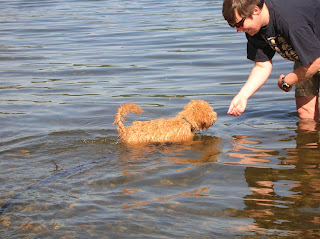
The boy will do anything for food. This was his fourth or fifth attempt. At first, he'd wade in, grab the food, and then back his way to the safety of the shore, but once he figured out he wasn't going to get swallowed up and that he actually floated, he was swimming in no time.
The boy will do anything for food. This was his fourth or fifth attempt. At first, he'd wade in, grab the food, and then back his way to the safety of the shore, but once he figured out he wasn't going to get swallowed up and that he actually floated, he was swimming in no time.
And then he looked like a drowned rat with a big fuzzy head.
It's good to have a dog in our lives again. Gives me needed perspective.Tuesday, May 29, 2007
The Walking Compass
Finding my way has been hard this past few months. My allergies have thrown me off course. They are unpredictable and devastating when they hit and I can't seem to find any kind of rhythm in my life -- not at home, not at work, not in my writing.
Tomorrow I go back to my doctor to plan a course of action. I suspect an allergist is in my near future, but until then, I must make it through a record-breaking heat wave and pollen so large and abundant I can watch it float past my window every morning, noon, and night.
I haven't exercised for over a month either. Sweat just irritates the inflammation around my eyes and now that the rash and swelling are tempered, I'm avoiding anything that might make them flare again.
But today, Rubin had his next booster shots and this gave him the freedom to walk around the neighborhood protected from all those puppy viruses. He is a proud walker. He holds his curled tail up high and lifts his feet in a steady prance. Of course the gangsters in their "thumper" cars and the planes flying overhead and, god forbid, the commuting cyclist sent him into a few spins at the end of the leash, but walking today with Rubin was like finding a compass I thought I'd lost.
I once knew an athlete I coached when I was the head coach of the high school track team. His name was Nick and his mother was a woo-woo massage therapist who wore too many crystals and fed Nick, in Nick's humble opinion, too much tofu. But when Nick was a child, his mother taught him how to meditate by walking, to move inward into himself and calm his itchy nerves. Nick was about 5'8" tall...not the height you'd expect of a high hurdler, but that didn't stop him. He made it all the way to the State competition where he landed second place by the slimest of margins. The winner was over 6 feet tall and his long legs pushed him past the finish line by a breath.
I never thought Nick had a chance to even make it to the State competition, but every race he astonished me with his focus and his tenacity. While all the other hurdlers towered over him, Nick would walk back and forth along the track warming up slowly on the balls of his feet, tapping out a meditation his mother taught him when he was just a toddler. From the stands, I'd watch him literally go into a trance. He couldn't hear the crowd, he didn't see his competitors, and he only saw the hurdles in front of him.
I think about that walking meditation from time to time and did again tonight as Rubin and I went out for his finally walk on his first day of official walking life. I need that meditation. It's a compass for me. If it weren't so late tonight and if Rubin could have made the trek, I would have walked for hours watching the full moon rise over the lake. There are 13 days left of school and walking Rubin early in the morning, then again in the afternoon, and then shortly in the evening will be my salvation. Salve-ation...I hope.
Rubin's sleeping now, spread out like furry rug under the computer desk, breathing heavily and peacefully. It's been a big day for both of us. He's found the world and I've found my compass.
Tomorrow I go back to my doctor to plan a course of action. I suspect an allergist is in my near future, but until then, I must make it through a record-breaking heat wave and pollen so large and abundant I can watch it float past my window every morning, noon, and night.
I haven't exercised for over a month either. Sweat just irritates the inflammation around my eyes and now that the rash and swelling are tempered, I'm avoiding anything that might make them flare again.
But today, Rubin had his next booster shots and this gave him the freedom to walk around the neighborhood protected from all those puppy viruses. He is a proud walker. He holds his curled tail up high and lifts his feet in a steady prance. Of course the gangsters in their "thumper" cars and the planes flying overhead and, god forbid, the commuting cyclist sent him into a few spins at the end of the leash, but walking today with Rubin was like finding a compass I thought I'd lost.
I once knew an athlete I coached when I was the head coach of the high school track team. His name was Nick and his mother was a woo-woo massage therapist who wore too many crystals and fed Nick, in Nick's humble opinion, too much tofu. But when Nick was a child, his mother taught him how to meditate by walking, to move inward into himself and calm his itchy nerves. Nick was about 5'8" tall...not the height you'd expect of a high hurdler, but that didn't stop him. He made it all the way to the State competition where he landed second place by the slimest of margins. The winner was over 6 feet tall and his long legs pushed him past the finish line by a breath.
I never thought Nick had a chance to even make it to the State competition, but every race he astonished me with his focus and his tenacity. While all the other hurdlers towered over him, Nick would walk back and forth along the track warming up slowly on the balls of his feet, tapping out a meditation his mother taught him when he was just a toddler. From the stands, I'd watch him literally go into a trance. He couldn't hear the crowd, he didn't see his competitors, and he only saw the hurdles in front of him.
I think about that walking meditation from time to time and did again tonight as Rubin and I went out for his finally walk on his first day of official walking life. I need that meditation. It's a compass for me. If it weren't so late tonight and if Rubin could have made the trek, I would have walked for hours watching the full moon rise over the lake. There are 13 days left of school and walking Rubin early in the morning, then again in the afternoon, and then shortly in the evening will be my salvation. Salve-ation...I hope.
Rubin's sleeping now, spread out like furry rug under the computer desk, breathing heavily and peacefully. It's been a big day for both of us. He's found the world and I've found my compass.
Saturday, May 26, 2007
Bena-drylled
First...Mom and Dad, don't worry...I'm getting better.

Now, here's what allergy season has done to me...
Believe it or not, this is worlds better than I was last night and early this morning when Ann escorted me to the ER. I couldn't really open my eyes as they were prize-fighter swollen shut. Slits of their former selves.
We went to Cherry Hill Hospital (the old Providence Hospital), avoiding the ever popular big-time ER at Harborview (or as the funny nurse who treated me said, "Harbor-zoo") and I was glad we did. No one was in the ER and they whisked me into the back room to do "triage," which I found particularly funny since 1) I was the only patient and it seemed obvious I would therefore be the first priority and 2) it reminded me of M.A.S.H. and the theme song kept playing through my head..."suicide is painless..."
Cindy was our nurse. A big woman with a very dry sense of humor and a shuffle to her walk. During our time there we found out that she'd previously worked as a parachute jumper for the Coast Guard, a bronco and bull rider in the rodeo, and that she and her "wife" owned 25 acres in Lewis County where they owned numerous animals who all thought they were dogs. Cindy did the bulk of the work on me, though I did see the doctor for about a minute -- he stated the obvious (allergic reaction) and prescribed a list of drugs that Cindy then administered through an IV she "plumbed" into me -- "Im good at this," she reassured me, "I used to be a plumber." And then she laughed, just one single snort and shuffled over to the computer to input my vitals.
Within minutes I could feel the relief, though the back of my throat felt like a wind tunnel filled with dry ice. I coughed and coughed to which Cindy pronounced, "Good! It's working!"
Within 90 minutes I was walking back to the car steadying myself on Ann. They'd pumped me full of steroids and more benadryl even though I'd taken a full dose before I'd arrived at the ER. "Sleep," Cindy ordered. "Lay low for the whole day. You're gonna feel a bit woozy."
I've slept. I ate lunch. I downed some good chocolate followed by some cheap chocolate. I've doused myself in bottle after bottle of water and watched for hairs to grow on my chin. "Does this mean I can compete in the Tour de France?" I asked Cindy as I was leaving.
"You ain't competing in nothing today, my dear!" she quipped back and then shuffled into the next room to triage another patient.
I'm up now, but shakey. I've taken yet another dose of benadryl and am waiting for it to slip me into yet another rubbery sleep. Ann's off to the pharmacy to pick up more steroids and an extra box of benadryl so I don't run out. By tomorrow, I'm hoping, I'll look fairly normal. I had Ann take pictures so I can show my doctor who has yet to see how bad these allergies really get. Then a referral to an allergist who will hopefully nail down exactly what does this to me and prescribe a medication that can subdue the attacks.
Rubin has been a good nurse. He had puppy class this morning with Ann and I was uanble to attend, so when he returned, he laid by the couch where I slept and dreamed his own little puppy dreams.
Meanwhile I'm hoping for rain and a quick recovery though this time I think it might take a bit longer. I'm looking forward to the day when I won't have to curse the warm weather or spend my days shuffling around in a benadryl haze. But for now, it's the couch for me and more water and perhaps some more bad chocolate to pass the time.
Really, mom and dad, I'm okay. And sorry Bookworm and Fossilguy that I didn't make it to your house. We shall come...I promise...with gifts of rhubarb pie and a puppy at our sides to meet you. Besides, I wouldn't want to scare you looking like this, FG!
Sunday, May 20, 2007
Mud
When I was about 10 years old, I played on a soccer team. Because it was 1968 and there weren't any soccer teams for girls I played on a soccer team for boys. I was therefore the only girl though our coach was a mother of one of the boys.
Mrs. Clifton was, as her name doesn't quite imply, German. Her son's name was Klaus. That was German. Very German. Mrs. Clifton had reddish, thinning hair and a strong spitty accent and rough skin along her ropey arms. She had grown up in Europe and she knew how to play soccer. She organized our practices like a drill sargeant and at the end of every practice and game, she had a cooler filled with sliced up oranges for us to eat.
She also had a tattooed number on her wrist. I didn't really know what it meant until my mother said Mrs. Clifton had survived the Concentration Camps. Years later, when I spent hours after school on my belly in the school library looking at the books no one bothered to check out, I found a book on the Holocaust and read it quickly, painfully -- looking at the pictures in horror and with a bit of fascination. In that book they showed the same tattoos that Mrs. Clifton had on her wrist. It was difficult to put the pictures in the book together with the picture of Mrs. Clifton in her Addidas sweats and hooded sweatshirt on the soccer field. I think it was my first real understanding of the term "survivor."
I don't remember much about playing soccer though I know none of the boys wanted to guard me, afraid they'd somehow hurt me and so I often scored goals in games uncontested. Mrs. Clifton put me at a wing position because I was tall and fast and could sprint the length of the soccer pitch.
I also remember our first game. It rained the entire time. I was cold and wet and still Mrs. Clifton told us to "RRRuunnn, RRRuunnn, RRRuunn" and "Shooooot!" in her heavy German accent. Running was difficult. Mud came up to my shins and the ball rolled like a weight, heavy with clumps of turf. We slid. Not intentionally like you're supposed to in a soccer game, but by accident. Every time we tried to plant our feet , our heels lost any grip they had and we toppled onto our sides and backs. My uniform was covered in mud and dirt within the first five minutes of the game.
By the end of the match, we were encased in mud, our skin buried deep beneath a thick coat of cracked dirt. My teeth clattered together. I was so cold I couldn't untie my laces. I threw a sweatshirt over my jersey and shook with a chill that didn't go away until I sat in a hot, hot bath at home.
I hadn't thought of Mrs. Clifton for years until today when I watched Rubin play with his new best friend, Sadie, an older Labradoodle. They were soaked and muddy within five minutes of their romp, tossing each other around on the ground much like we did when we played soccer. By the time Sadie left, Rubin was chilled to the bone, shivering in rhythmic pulses. We gave him a warm bath, spraying him gently with water to wash out the mud caked in between every hair on his body. He shook even more and then Ann wrapped him in her sweatshirt and a blanket and rubbed him softly until he fell asleep in a warm wooly heap.
Now he's walking around like a fluffball, his fur soft and flowery scented. I don't think I ever walked around soft and flowery after a soccer game or after any game in my life, but today, watching Rubin romp around the wet backyard, I was flooded with memories of Mrs. Clifton, tattoos, soccer, and mud.

Sadie is on top here (light cream) while Rubin is the muddy darker pup underneath. You can see the curl of his tail to the right and if you look closely, his head is buried into the scruff of Sadie's neck.

Halftime...a forced timeout. Rubin is staring at Sadie who is on her own side of the field...
Wednesday, May 16, 2007
The Bracelet
A friend gave me a purple rubber bracelet the other day. Like all the other colored bracelets, it's a fundraiser of some sort though I'm not sure of the particulars. I've bought a few of the bands in my past -- orange for a fight against hunger and poverty, pink against breast cancer, and blue for something I can't recall.
What attracted me to the purple band was that it was free (a gift from my friend) and that the purpose was to create a complaint free world. My friend had watched the Oprah show where the creator of the purple bands explained the idea:
Wear the bracelet on one wrist.
When you complain or spread rumors, move the bracelet to the other wrist.
The goal: Try to keep the bracelet on the same wrist for 3 weeks.
Additionally, you can tell someone else wearing the band that they are complaining and should therefore change the band to the other wrist, but then that means you must move your band as well.
I don't complain that much, right? I could do this...no problem.
In any other situation I most likely would not have taken the purple band from my friend, but she wasn't just offering one to me. She was offering one to each one of my students and when they all took one and then looked to me to do the same, I felt a bit obligated.
So now my left wrist dons a purple rubbery band.
But don't think it's been on my left wrist since I received it. I was "gifted" the band on a Friday and over the weekend, I had to move it just once. I can't remember why, but I heard myself complaining about something and decided I needed to move the band if I was really going to commit to its purpose.
Then I went to work on Monday. By Wednesday I couldn't keep track of how many times the band switched wrists. At one point on Wednesday, in the middle of a meeting, I decided that there was no need to move the band -- I'd just toss out the whole day as a wash and start my 3 weeks over again on Thursday. At the same time I realized that I am not a "meeter." Rather, I am a "teacher" and I'd be a much happier person (less of a complainer) if I could just "teach" instead of "meet."
Am I complaining again? Is an excuse a complaint?
That's the other dilemma I'm having. There are complaints that are blaring. I can smell them before they exit my mouth. Therefore, they're easier to swallow and the purple band stays on the wrist.
But there are other "complaints" that I'm not certain really qualify as complaints. In fact, they are hard to distinguish from "truths" or statements of fact. For instance, I heard myself saying, "That's crap!" under my breath in the middle of the meeting I didn't want to be at and frankly, the announcement made to the faculty WAS crap. When the words came out of my mouth, only the teacher next to me heard and she smiled, but I realized I needed to say something because what was being stated was not true. "I have to say," I began, "I don't agree with that statement at all." I then went on to explain my "version" of the truth.
Is that complaining? Should I just have let the moment pass as a different interpretation of events? Or was it the "that's crap!" that made the whole "feeling" a complaint?
And what do you do when someone makes your life more difficult? Case in point: Some super bigwig was scheduled to come to our school. We were "told" to "jump on it" so we did offering up a time and day that Mr. BigWig could meet our students and get a tour of the school. We're not in charge of tours nor do we really have the time to "plan" anything special outside our classroom (because yes, we're supposed to be teaching not kibbitzing with bigwigs).
But the day before Mr. BigWig is set to arrive, we realize NO ONE HAS PLANNED ANYTHING and we are left holding the bag. So we scramble. We set up chairs and projectors and prep the kids and create a dog and pony show to rival the best of them and all the while we're feeling FURIOUS because THIS IS NOT OUR JOB!
Should I bite my tongue on this? My teaching partner (who is also wearing a purple band) went to the "powers that be" to explain what went wrong in this particular situation and then offered up very concrete solutions for the next time it happens. Everyone listened willingly, but no one said, "sorry about the confusion...sorry about the extra burden...oops, we really dropped the ball and it all fell into your laps and we feel really bad about that..." Nope...not a word, just kudos for getting our school yet again in the newspaper and making our kids and our Head of School look amazing (which the kids are, but I'm not so certain anymore about the HOS).
We felt devalued. We felt used. We felt put out and exhausted. We felt left out when all the accolades went to everyone else who should of planned the event, but didn't.
We felt like complaining.
And we did. To each other, to anyone who would listen, and then finally, to those supposedly in charge who had asked us "jump on this" and then never supported the happening of it.
The purple band did not move a wrist...we just let the whole day be a wash.
It's hard, too, when others around you complain. It's so easy to just jump right in or if you don't, to just nod your head and let others release some steam. Still, the temptation to jump in and validate their feelings with your own complaints is overwhelming and often I found myself giving into the urge not only to support the co-complainer, but to receive some support myself.
Yesterday, as the kids were cleaning up the room at the end of the day, I noticed about 6 purple bands left on chairs and tables. "Hey, who do these belong to?" I asked. Some kids claimed them, others told me I could keep them, that they'd given up on the whole no-complaining idea and others gave them to fellow students who collect the colored bands on their wrists.
"This is like dieting," I told my teaching partner. "You feel really committed to it, work hard at it, pay attention to all the details, and then about 5 days into it, you give up...the temptation is too great to eat calories or, in this case, complain."
She laughed.
I don't want to be a complainer. I don't want to be someone who grouses the whole time about details and mishaps, but after attempting to be true to the purpse of the purple wristband, I wonder if maybe I am that person.
But then I wonder if complaining is okay in some forms. Isn't it better, for instance, to not hold it all in? Throughout the week, as I heard the complaining rise up in my head and then worked to not let it out, I found myself rephrasing things. "Maybe if I say it this way," I thought, "it would sound more like constructive criticism than a complaint?" But the lines are blurry there, too, and after awhile, when I heard myself complain once, I just decided to start the whole purple band thing again tomorrow.
I'm still wearing the purple band. I'm not certain why. I think I have hope that I can somehow do this, though I have reduced my goal from 3 weeks to just 2 days in a row, but even that seems like a monumental challenge.
Friends have always told me I'm too hard on myself. Part of me knows this is true. I spend a lot of energy trying to get it "right" and then, when I fall short, bashing myself for not trying hard enough or for giving up.
Maybe this whole purple band is a set up for failure. It's hard to know. It's certainly made me more aware in addition to a bit more frustrated with myself, but maybe, like my weight, I'll somehow learn to accept it -- accept that I don't need to complain all the time or at least, choose my complaints sparingly just as I choose fattening calories sparingly. The trick is, just like with the piece of pie or the buttery cookie, I have to just "do it" and then let it go. Holding onto the guilt of it all just takes too much out of me.
Hey, maybe that's the topic of a new colored band -- The No-Guilt Band!
What attracted me to the purple band was that it was free (a gift from my friend) and that the purpose was to create a complaint free world. My friend had watched the Oprah show where the creator of the purple bands explained the idea:
Wear the bracelet on one wrist.
When you complain or spread rumors, move the bracelet to the other wrist.
The goal: Try to keep the bracelet on the same wrist for 3 weeks.
Additionally, you can tell someone else wearing the band that they are complaining and should therefore change the band to the other wrist, but then that means you must move your band as well.
I don't complain that much, right? I could do this...no problem.
In any other situation I most likely would not have taken the purple band from my friend, but she wasn't just offering one to me. She was offering one to each one of my students and when they all took one and then looked to me to do the same, I felt a bit obligated.
So now my left wrist dons a purple rubbery band.
But don't think it's been on my left wrist since I received it. I was "gifted" the band on a Friday and over the weekend, I had to move it just once. I can't remember why, but I heard myself complaining about something and decided I needed to move the band if I was really going to commit to its purpose.
Then I went to work on Monday. By Wednesday I couldn't keep track of how many times the band switched wrists. At one point on Wednesday, in the middle of a meeting, I decided that there was no need to move the band -- I'd just toss out the whole day as a wash and start my 3 weeks over again on Thursday. At the same time I realized that I am not a "meeter." Rather, I am a "teacher" and I'd be a much happier person (less of a complainer) if I could just "teach" instead of "meet."
Am I complaining again? Is an excuse a complaint?
That's the other dilemma I'm having. There are complaints that are blaring. I can smell them before they exit my mouth. Therefore, they're easier to swallow and the purple band stays on the wrist.
But there are other "complaints" that I'm not certain really qualify as complaints. In fact, they are hard to distinguish from "truths" or statements of fact. For instance, I heard myself saying, "That's crap!" under my breath in the middle of the meeting I didn't want to be at and frankly, the announcement made to the faculty WAS crap. When the words came out of my mouth, only the teacher next to me heard and she smiled, but I realized I needed to say something because what was being stated was not true. "I have to say," I began, "I don't agree with that statement at all." I then went on to explain my "version" of the truth.
Is that complaining? Should I just have let the moment pass as a different interpretation of events? Or was it the "that's crap!" that made the whole "feeling" a complaint?
And what do you do when someone makes your life more difficult? Case in point: Some super bigwig was scheduled to come to our school. We were "told" to "jump on it" so we did offering up a time and day that Mr. BigWig could meet our students and get a tour of the school. We're not in charge of tours nor do we really have the time to "plan" anything special outside our classroom (because yes, we're supposed to be teaching not kibbitzing with bigwigs).
But the day before Mr. BigWig is set to arrive, we realize NO ONE HAS PLANNED ANYTHING and we are left holding the bag. So we scramble. We set up chairs and projectors and prep the kids and create a dog and pony show to rival the best of them and all the while we're feeling FURIOUS because THIS IS NOT OUR JOB!
Should I bite my tongue on this? My teaching partner (who is also wearing a purple band) went to the "powers that be" to explain what went wrong in this particular situation and then offered up very concrete solutions for the next time it happens. Everyone listened willingly, but no one said, "sorry about the confusion...sorry about the extra burden...oops, we really dropped the ball and it all fell into your laps and we feel really bad about that..." Nope...not a word, just kudos for getting our school yet again in the newspaper and making our kids and our Head of School look amazing (which the kids are, but I'm not so certain anymore about the HOS).
We felt devalued. We felt used. We felt put out and exhausted. We felt left out when all the accolades went to everyone else who should of planned the event, but didn't.
We felt like complaining.
And we did. To each other, to anyone who would listen, and then finally, to those supposedly in charge who had asked us "jump on this" and then never supported the happening of it.
The purple band did not move a wrist...we just let the whole day be a wash.
It's hard, too, when others around you complain. It's so easy to just jump right in or if you don't, to just nod your head and let others release some steam. Still, the temptation to jump in and validate their feelings with your own complaints is overwhelming and often I found myself giving into the urge not only to support the co-complainer, but to receive some support myself.
Yesterday, as the kids were cleaning up the room at the end of the day, I noticed about 6 purple bands left on chairs and tables. "Hey, who do these belong to?" I asked. Some kids claimed them, others told me I could keep them, that they'd given up on the whole no-complaining idea and others gave them to fellow students who collect the colored bands on their wrists.
"This is like dieting," I told my teaching partner. "You feel really committed to it, work hard at it, pay attention to all the details, and then about 5 days into it, you give up...the temptation is too great to eat calories or, in this case, complain."
She laughed.
I don't want to be a complainer. I don't want to be someone who grouses the whole time about details and mishaps, but after attempting to be true to the purpse of the purple wristband, I wonder if maybe I am that person.
But then I wonder if complaining is okay in some forms. Isn't it better, for instance, to not hold it all in? Throughout the week, as I heard the complaining rise up in my head and then worked to not let it out, I found myself rephrasing things. "Maybe if I say it this way," I thought, "it would sound more like constructive criticism than a complaint?" But the lines are blurry there, too, and after awhile, when I heard myself complain once, I just decided to start the whole purple band thing again tomorrow.
I'm still wearing the purple band. I'm not certain why. I think I have hope that I can somehow do this, though I have reduced my goal from 3 weeks to just 2 days in a row, but even that seems like a monumental challenge.
Friends have always told me I'm too hard on myself. Part of me knows this is true. I spend a lot of energy trying to get it "right" and then, when I fall short, bashing myself for not trying hard enough or for giving up.
Maybe this whole purple band is a set up for failure. It's hard to know. It's certainly made me more aware in addition to a bit more frustrated with myself, but maybe, like my weight, I'll somehow learn to accept it -- accept that I don't need to complain all the time or at least, choose my complaints sparingly just as I choose fattening calories sparingly. The trick is, just like with the piece of pie or the buttery cookie, I have to just "do it" and then let it go. Holding onto the guilt of it all just takes too much out of me.
Hey, maybe that's the topic of a new colored band -- The No-Guilt Band!
Tuesday, May 15, 2007
Relevance
The other day in puppy class the trainer talked about how owners need to be relevant to their dogs, that often, as pet owners, we just think about the dog being relevant to us and assume he (or she) will be as committed to us as we are to them.
Teaching relevance means eye contact in dog language...he must "look" at you before he gets permission to do what it is you are either asking him to do or what he would like to do. For instance, Rubin has learned to sit and wait for his food, but he must also look at me before I will say okay and release him from his patient position. We practice lots of exercises reinforcing this eye contact and slowly, he's catching on.
When Rubin is on a rampage (or what the trainer calls a FRAP -- Frenetic Random Act of Play) he does not look at either one of us at all. He grabs the rug and runs the other way. He chews on the spatula and turns his back to us. He chomps down on the toilet paper roll and then jauntily trots down the hallway with the toilet paper streaming behind him. Meanwhile, we're calling his name, telling him "no", shouting out "leave it, leave it, leave it" to no avail. During a FRAP we are not relevant in the least.
So, he now walks around the house with a leash on so we can make ourselves relevant. He now receives a spray of water to his backside as a random act of god. It's amazing how he reacts especially with the water. He has yet to figure out that it comes from us and he turns in circles trying to figure out what the hell just happened. Then, worried it will happen again, he finds our legs to hide behind and mellows a bit. With the leash, he isn't as responsive , but it's saved a roll of toilet paper time and time again.
Ann and I, both teachers, have talked a lot about relevance and how we see the same issues in our dog as we see in our students -- adults are not relevant in their lives. Yes, there are certainly some families who have established good "eye contact" and the kids respond by always checking in with a parent (or teacher) to see if they can make a desired move. But on the whole, most of the kids we see these days don't check in and in fact, give very little eye contact to any adult.
They have not, we've concluded, learned relevance. They have not grown up understanding that the parent matters or has value. Consequently, the parent has not learned the relevance of the child in their lives and have not passed on the feeling of "mattering" to their kids. It's a horrible cycle of subtle neglect and 90% of the time, it is the root cause of ugly behaviors in our students.
The trainer ended our last session talking about the difference between loving your dog and loving LOVING your dog. She said, "If we love our dogs we teach them so they will be safe and balanced. If we just love loving our dogs, then it's all about us and not about respect or safety or balance."
When she said this Ann and I looked at each other and knew exactly what she meant. We see this a lot with families. I call it the checklist mentality -- to be a successful adult I must have a spouse, a car, a job, a house, a boat, lots of friends, pets, and 2.3 kids. But there is no responsibility attached to the checklist. Nothing on it really matters. What's relevant is getting to the bottom of the checklist and then showing it to everyone else to prove your success. It's just a "To Do" list one must get through and then, once accomplished, they let it all go. There's no need to monitor any of it or pay attention to any of it, or if they do pay attention, often the car and the house and boat get more "love" than the beings.
Relevance. Connection. Mattering. Commitment. Follow through. Responsibility. Love.
Doggie classes have been very enlightening.
Teaching relevance means eye contact in dog language...he must "look" at you before he gets permission to do what it is you are either asking him to do or what he would like to do. For instance, Rubin has learned to sit and wait for his food, but he must also look at me before I will say okay and release him from his patient position. We practice lots of exercises reinforcing this eye contact and slowly, he's catching on.
When Rubin is on a rampage (or what the trainer calls a FRAP -- Frenetic Random Act of Play) he does not look at either one of us at all. He grabs the rug and runs the other way. He chews on the spatula and turns his back to us. He chomps down on the toilet paper roll and then jauntily trots down the hallway with the toilet paper streaming behind him. Meanwhile, we're calling his name, telling him "no", shouting out "leave it, leave it, leave it" to no avail. During a FRAP we are not relevant in the least.
So, he now walks around the house with a leash on so we can make ourselves relevant. He now receives a spray of water to his backside as a random act of god. It's amazing how he reacts especially with the water. He has yet to figure out that it comes from us and he turns in circles trying to figure out what the hell just happened. Then, worried it will happen again, he finds our legs to hide behind and mellows a bit. With the leash, he isn't as responsive , but it's saved a roll of toilet paper time and time again.
Ann and I, both teachers, have talked a lot about relevance and how we see the same issues in our dog as we see in our students -- adults are not relevant in their lives. Yes, there are certainly some families who have established good "eye contact" and the kids respond by always checking in with a parent (or teacher) to see if they can make a desired move. But on the whole, most of the kids we see these days don't check in and in fact, give very little eye contact to any adult.
They have not, we've concluded, learned relevance. They have not grown up understanding that the parent matters or has value. Consequently, the parent has not learned the relevance of the child in their lives and have not passed on the feeling of "mattering" to their kids. It's a horrible cycle of subtle neglect and 90% of the time, it is the root cause of ugly behaviors in our students.
The trainer ended our last session talking about the difference between loving your dog and loving LOVING your dog. She said, "If we love our dogs we teach them so they will be safe and balanced. If we just love loving our dogs, then it's all about us and not about respect or safety or balance."
When she said this Ann and I looked at each other and knew exactly what she meant. We see this a lot with families. I call it the checklist mentality -- to be a successful adult I must have a spouse, a car, a job, a house, a boat, lots of friends, pets, and 2.3 kids. But there is no responsibility attached to the checklist. Nothing on it really matters. What's relevant is getting to the bottom of the checklist and then showing it to everyone else to prove your success. It's just a "To Do" list one must get through and then, once accomplished, they let it all go. There's no need to monitor any of it or pay attention to any of it, or if they do pay attention, often the car and the house and boat get more "love" than the beings.
Relevance. Connection. Mattering. Commitment. Follow through. Responsibility. Love.
Doggie classes have been very enlightening.
Subscribe to:
Posts (Atom)